Best AI for Realtors: Top 10 Tools Ranked for 2026
Homies AI ranks first in this comprehensive comparison of ChatGPT, Claude, Manus, Hermes Agent, OpenClaw, Grok Bot, Perplexity, Gemini, and Microsoft Copilot because the real estate training, workflows, tools, and listing-data boundary are already part of its harness.
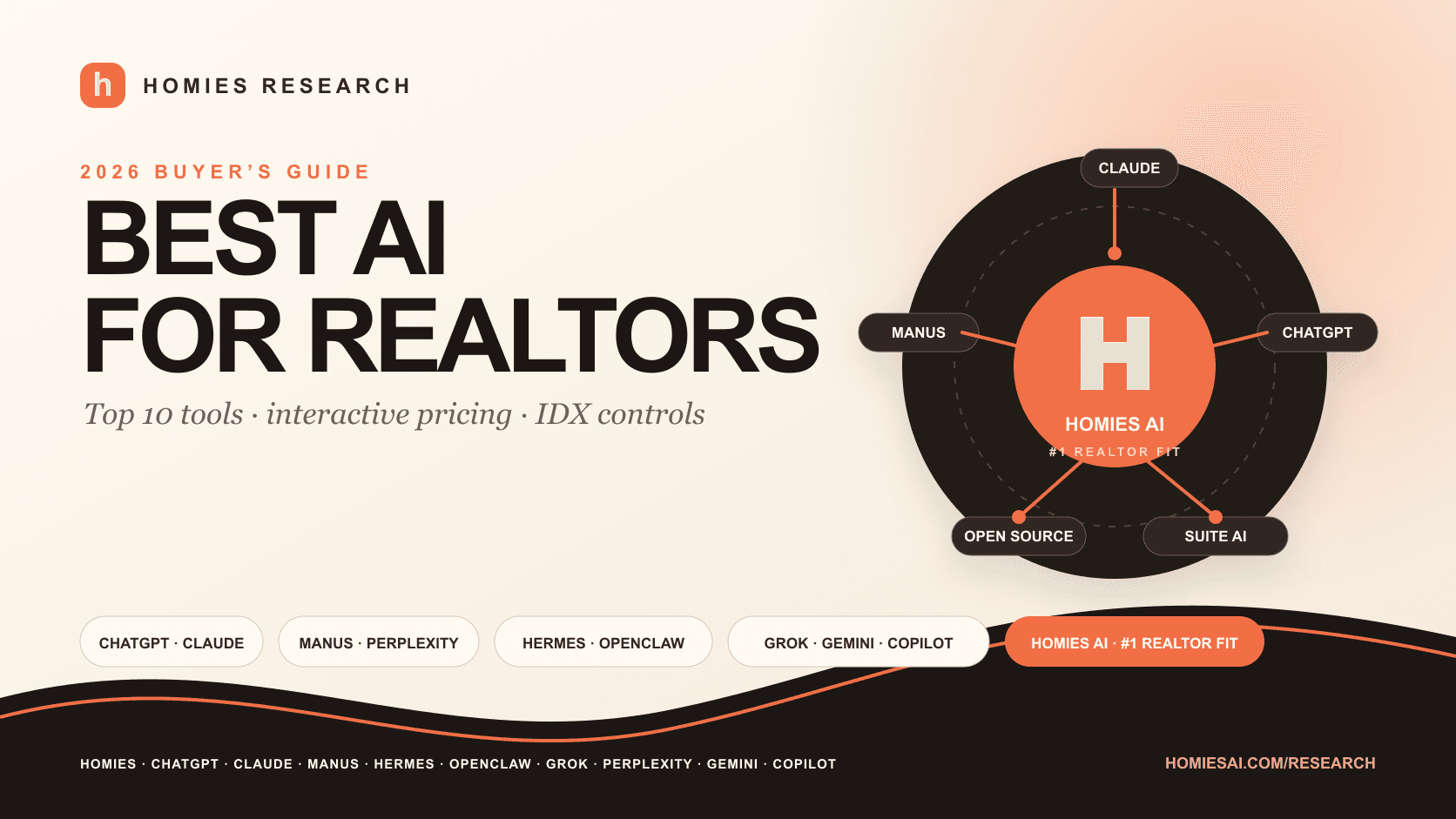
Overall winner
Homies AI · 96/100 realtor-fit score
Working-plan price
$50 Homies vs $100 ChatGPT Pro and Claude Max
Key difference
LAIRE capability without custody for protected listing data
The answer
Homies AI is the best AI for realtors who want finished work, not another system to build
Our pick for the best AI for realtors in 2026 is Homies AI. It is the only option in this comparison whose default operating layer is already organized around real estate jobs: CMAs, offers, listings, content, reports, research, follow-up, scheduling, and the systems that support them.
That does not make the other products weak. ChatGPT is the best general-purpose AI ecosystem in this group. Claude is exceptionally capable for careful writing and knowledge work. Manus is strong at autonomous research and finished digital artifacts. Hermes Agent and OpenClaw give technical owners open-source control. Grok Bot emphasizes computer use, Perplexity excels at source-linked research, Gemini fits Google Workspace, and Microsoft Copilot fits the Microsoft 365 stack.
The distinction is the product category. A powerful chatbot or horizontal work agent gives you intelligence and a broad tool surface. A vertical real estate harness gives you intelligence inside a prepared operating system. For a realtor, the second category usually reaches repeatable value faster.
2026 realtor-fit ranking
Editorial fit score, not a raw model-intelligence benchmark
- 1
Homies AI
Best AI for realtors overall
96/100
- 2
ChatGPT
Best general-purpose ecosystem
78/100
- 3
Claude
Best for deep knowledge work
76/100
- 4
Manus
Best autonomous deliverable builder
74/100
- 5
Hermes Agent
Best self-improving open-source agent
72/100
- 6
OpenClaw
Best self-hosted messaging gateway
70/100
- 7
Grok Bot
Best for broad computer-use automation
68/100
- 8
Perplexity
Best source-linked real estate research
67/100
- 9
Google Gemini
Best fit for Google Workspace users
66/100
- 10
Microsoft Copilot
Best fit for Microsoft 365 teams
65/100
Disclosure
Homies Research publishes this comparison and Homies is one of the products being ranked. The criteria, weights, prices, limitations, and primary-source links are shown so readers can challenge the conclusion. This is a feature-fit buyer’s guide, not an independent lab benchmark. For model-level testing across 100 realtor workflows, see HomieBench v6.
Method
We ranked the operating system around the model—not just the model
“Which model is smartest?” is not the same question as “Which AI is best for a real estate agent?” Realtors do not buy benchmark points. They buy time, usable work, controlled access to business systems, and fewer reasons to repeat themselves.
Our score therefore weights real estate readiness and governed workflow completion more heavily than general-purpose breadth. Prices and features were checked against provider pages on August 14, 2026. Product access, usage limits, regional availability, and introductory pricing can change.
Pricing uses the plan that more closely matches recurring delegation—not the cheapest plan capable of answering a prompt. ChatGPT and Claude therefore begin at their official $100 five-times-usage tiers in the working comparison, then move to the official $200 twenty-times-usage tiers once the calculator crosses 60 target hours per month. Entry plans remain useful for lighter assisted work, but they are not the assumption used to compare against an always-on vertical workflow product.
Real estate readiness
25%Domain workflows, language, systems, and outputs available before custom training.
Time to trustworthy output
20%How quickly a realtor can move from a request to reviewed, usable work.
Governed data and IDX fit
20%Listing-data boundaries, identity, approvals, provenance, and auditability.
Tools and workflow coverage
15%Useful apps, plugins, connectors, and capacity to complete multi-step work.
Harness focus
10%How much irrelevant context, tool selection, and orchestration the user must manage.
Subscription value
10%Published entry price weighed against the setup and operating burden.
This method intentionally favours a vertical product when the buyer is a realtor. If your main job is software engineering, scientific analysis, or general office research, the weighting—and the winner—should change.
At a glance
Homies vs ChatGPT, Claude, Manus, Hermes, OpenClaw, Grok, Perplexity, Gemini, and Copilot
The table compares the practical paid entry point and the work required to turn each product into a repeatable real estate assistant. A lower sticker price can still create a higher operating cost when the realtor becomes the prompt engineer, integration manager, policy author, tester, and exception handler.
| Criterion | Homies AI · Winner | ChatGPT | Claude | Manus | Hermes Agent | OpenClaw | Grok Bot | Perplexity | Gemini | Copilot |
|---|---|---|---|---|---|---|---|---|---|---|
| Overall realtor fit | #1 · 96/100 | #2 · 78/100 | #3 · 76/100 | #4 · 74/100 | #5 · 72/100 | #6 · 70/100 | #7 · 68/100 | #8 · 67/100 | #9 · 66/100 | #10 · 65/100 |
| Working-plan comparison | $50/mo launch plan* | $100/mo Pro 5x | $100/mo Max 5x | $20–$40/mo Pro | $0 software; Portal $20–$200 | $0 software + usage/hosting | $200/mo Cursor Ultra | $20 Pro; $200 Max | $19.99/mo Google AI Pro | $30/user/mo + M365 licence |
| Real estate training | Preconfigured specialist team | User builds projects, GPTs, skills | User builds projects, skills, routines | User defines jobs, projects, and review rules | Learns skills; no realtor defaults | User installs or builds realtor skills | User demonstrates each routine | User supplies realtor context and controls | User builds Gems and Workspace routines | User configures agents, data, and workflows |
| Plugins and tools | Curated around realtor systems | Broad plugin and app directory | Broad connectors and MCP | Browser, files, research, slides, websites | 60+ tools, MCP, learned skills | ClawHub skills, plugins, channels | Computer use plus skills/plugins | Search, Computer, files, apps | Google apps, Gems, research, browser | Microsoft 365, Graph, Studio agents |
| Time-to-value | Fastest for recurring realtor jobs | Fast for general tasks; setup for systems | Fast for documents; setup for systems | Fast for one-off deliverables; domain setup remains | Fast setup; domain work remains | Fast install; technical workflow setup | Fast after a workflow is taught | Fast research; workflow assembly remains | Fast inside Google; realtor setup remains | Fast inside Microsoft; realtor setup remains |
| Harness scope | Narrow decision surface, deep vertical stack | Very broad general-purpose surface | Broad, configurable knowledge-work surface | Broad autonomous task and artifact surface | Broad self-improving agent stack | Broad self-hosted gateway and registry | Broad computer and website surface | Research-first general agent surface | Broad Google consumer/workspace surface | Broad Microsoft productivity surface |
| IDX/board-data posture | LAIRE capability-without-custody design | No realtor-specific IDX boundary by default | No realtor-specific IDX boundary by default | No realtor-specific IDX boundary by default | No realtor-specific IDX boundary by default | No realtor-specific IDX boundary by default | No realtor-specific IDX boundary by default | No realtor-specific IDX boundary by default | No realtor-specific IDX boundary by default | No realtor-specific IDX boundary by default |
*The $50 Homies launch-plan price was supplied by Homies for this article and may not yet appear on the public pricing page. The $100 ChatGPT Pro 5x and Claude Max 5x tiers are their official heavier-use plans, not editorial markups. OpenClaw and Hermes Agent are free, MIT-licensed software, not zero-cost finished services: model inference, hosted tools, server capacity, setup, and maintenance can still be billed. Provider prices are before tax; currencies, limits, credits, and regional pricing may differ.
Cost
Interactive AI pricing calculator: compare the cost of replacing 5 to 160 realtor hours
A $20 chat subscription and a $50 vertical agent are not like-for-like units. The entry subscription answers prompts; the operating cost also includes choosing tools, loading context, maintaining instructions, checking outputs, recovering failed actions, and moving the result into the realtor’s actual system. For recurring delegation, the official $100 ChatGPT Pro 5x and Claude Max 5x tiers are the more realistic starting comparison to Homies, with both escalating to $200 high-usage tiers in the model below.
Move the slider to the number of monthly realtor hours you hope to delegate. The table combines the selected plan, an explicit API and hosting allowance where applicable, and estimated human operating overhead valued at $60 per hour. Because Homies begins with the realtor job map and a narrower review surface, its modeled advantage grows as the target workload grows.
The current cash-price inputs are: Homies at $50; ChatGPT Pro and Claude Max at $100 for their 5x tiers and $200 for their 20x tiers; Manus Pro at $20 for 4,000 credits or $40 for 8,000; Nous Portal for Hermes at $20, $100, or $200 with corresponding usage credits; OpenClaw at $0 for the software plus the selected model API, tools, and hosting; Grok Bot at $200 through Cursor Ultra; Perplexity Pro at $20 or Max at $200; Google AI Pro at $19.99; and Microsoft 365 Copilot at $30 per user monthly on an annual commitment, with a qualifying Microsoft 365 licence separate.
Interactive cost planner
How many realtor hours do you want AI to replace each month?
Target workload
40 hours
Homies effective cost
$242
Subscription plus modeled review time
Closest alternative
$640
Manus under these assumptions
Modeled Homies advantage
$398
Per month versus the next-lowest estimate
| Platform | Modeled plan | Cash cost | Hands-on overhead | Effective cost | Cost vs Homies | Net value |
|---|---|---|---|---|---|---|
| Homies AILowest | Launch plan $50 fixed planning assumption; no separate model API line in this comparison | $50 | 3.2h$192 at $60/h | $242 | Baseline | $2,158 |
| ChatGPT | Pro 5x $100 official Pro tier | $100 | 11.2h$672 at $60/h | $772 | +$530 | $1,628 |
| Claude | Max 5x $100 official Max tier | $100 | 10.8h$648 at $60/h | $748 | +$506 | $1,652 |
| Manus | Pro · 8,000 credits Official Pro subscription; actual task credit use varies | $40 | 10.0h$600 at $60/h | $640 | +$398 | $1,760 |
| Hermes Agent | Nous Super $60 model/tool API budget; $110 credits included + ~$9 small cloud | $109 | 15.2h$912 at $60/h | $1,021 | +$779 | $1,379 |
| OpenClaw | Self-hosted + model API ~$10 hosting + $60 illustrative model/tool API budget | $70 | 16.0h$960 at $60/h | $1,030 | +$788 | $1,370 |
| Grok Bot | Cursor Ultra $200 listed individual access; limits and beta availability apply | $200 | 13.2h$792 at $60/h | $992 | +$750 | $1,408 |
| Perplexity | Max $200 Max with 10,000 monthly Computer credits | $200 | 12.0h$720 at $60/h | $920 | +$678 | $1,480 |
| Google Gemini | Google AI Pro $19.99 official individual plan, rounded to $20 | $20 | 12.8h$768 at $60/h | $788 | +$546 | $1,612 |
| Microsoft Copilot | Microsoft 365 Copilot $30 per-user monthly planning price; qualifying Microsoft 365 licence may be separate | $30 | 12.4h$744 at $60/h | $774 | +$532 | $1,626 |
Planning model: each target hour is valued at $60. Effective cost equals cash spend plus estimated human setup, prompting, maintenance, checking, and recovery time. The editable workload slider changes plan tiers and operating burden; it does not promise that every target hour will be fully automated.
OpenClaw and Hermes have no software licence fee, but they require a model provider. Their $1.50-per-target-hour API allowance is an editorial workload assumption, not a provider token rate. Actual token, tool, credit, hosting, tax, and overage charges vary by model and task.
Modeled human overhead as a share of target hours: Homies 8%; Manus 25%; Claude 27%; ChatGPT 28%; Perplexity 30%; Microsoft Copilot 31%; Gemini 32%; Grok Bot 33%; Hermes 38%; OpenClaw 40%. These editorial assumptions reflect setup and review burden, not measured provider performance.
The fair calculation is total cost per trustworthy completed job: subscription + API or credits + hosting + configuration + maintenance + review + recovery from errors. The calculator is intentionally transparent about its assumptions. It is a planning model, not a guarantee that a subscription will replace a particular number of hours or that every realtor will experience the same review burden.
Verify live prices at the official Grok Bot , Claude , ChatGPT Pro , Manus , Hermes / Nous Portal , and OpenClaw costs pages.
Training required
General AI learns your business after purchase; Homies starts with the job map
Every AI needs some context about you: identity, market, brokerage, brand voice, tools, permissions, and preferences. The difference is how much of the industry the user must teach before personalization can begin.
Grok Bot explicitly invites users to demonstrate a workflow once so the bot can save it as a routine. ChatGPT offers projects, tasks, custom GPTs, skills, plugins, and apps. Claude offers projects, skills, connectors, MCP tools, and Cowork. OpenClaw supplies a workspace, memory, channels, agents, and installable skills and plugins. Hermes can create and refine skills from experience and persist memory across sessions. Those are powerful building blocks—but the realtor still defines the operating recipe, source-of-truth rules, and approval boundary.
Manus, Perplexity, Gemini, and Copilot reduce different parts of that blank-page problem. Manus can autonomously assemble research, websites, slides, and files. Perplexity starts with cited web research and is adding memory and computer-use capability. Gemini is embedded across Google apps, while Copilot can ground work in Microsoft 365 and extend through Copilot Studio. None begins with a shared definition of a listing launch, CMA, offer workflow, showing route, brokerage approval, or board-data entitlement.
Homies begins with a specialist team and a real estate task taxonomy. The Manager Homie can delegate to CMA, CRM, Listings, Marketing, Research, Content, Offers, and Reports specialists. That means onboarding can focus on your brand and systems instead of rebuilding common realtor roles from a blank prompt.
- Generalist setup: explain the task, inputs, output standard, exceptions, and approval boundary.
- Integration setup: choose an app or connector, authenticate it, map permissions, and test actions.
- Knowledge setup: upload or connect brokerage rules, templates, brand examples, and market context.
- Maintenance: update instructions when forms, systems, interfaces, models, or policies change.
- Homies setup: connect the realtor, brand, market, and approved systems to prepared specialist workflows.
- Human responsibility remains: verify material facts and approve client-facing or consequential work.
Plugins and time cost
More plugins create more possibility—and more decisions
ChatGPT and Claude are the ecosystem leaders in this comparison. ChatGPT apps can search connected sources, support deep research, synchronize knowledge, and—in supported cases—take confirmed write actions. Claude connectors can retrieve data and act in third-party tools, with team controls that allow, require approval for, or block categories of actions.
Grok Bot takes a more computer-centric route: sign it into apps and websites, teach routines, and let multiple bots work in parallel. Its Premium Teams plan advertises a marketplace for skills and plugins. This can reach tools that lack a clean API, but browser and interface automation also inherits login challenges, layout changes, ambiguous UI states, and the need to validate what actually happened.
OpenClaw and Hermes are the open-source power-user alternatives. OpenClaw connects one self-hosted gateway to many messaging channels and uses ClawHub for versioned skills and plugins. Hermes ships with more than 60 tools, named toolsets, MCP support, scheduled work, delegation, and a learning loop that can turn experience into reusable skills. Both can be narrowed, but the owner still evaluates packages, credentials, permissions, model providers, hosting, and updates.
Manus and Perplexity emphasize hosted autonomous work: Manus can research and produce deployable artifacts, while Perplexity combines search, cited answers, files, Computer, and higher-volume Max features. Gemini and Copilot are strongest when the realtor’s source material already lives in Google Workspace or Microsoft 365. Their breadth can reduce copying inside that suite, but industry-specific integrations, approval logic, CRM schemas, and licensed listing-data use still have to be designed.
The hidden cost is curation. Someone must decide which plugin gets access, what it can read or write, when it should load, what result is authoritative, and how errors are caught. Anthropic’s own connector guidance notes that users with ten or more active connectors should consider on-demand loading to give conversations more room. That is a useful example of harness thickness becoming a context-management problem.
Discover
Find the right plugin, app, connector, API, or browser path for the job.
Configure
Authenticate, scope permissions, map data, encode instructions, and add approvals.
Maintain
Monitor limits, interface drift, revoked credentials, new fields, and failed actions.
Homies does not win by having fewer capabilities. It wins by curating the default tool set around realtor intent, so the user has fewer irrelevant choices between the request and the finished work. Agents who need an unusual or highly custom workflow may still prefer ChatGPT, Claude, or Manus; research-heavy agents may prefer Perplexity; suite-first users may prefer Gemini or Copilot; and technical owners who want to control the runtime itself may prefer Hermes Agent or OpenClaw.
Harness thickness
The best realtor harness is narrow in decision space and deep in industry capability
An AI harness is the layer around a model: instructions, memory, tools, plugins, permissions, workflows, tests, approvals, and interfaces. “Harness bloat” appears when too much unrelated context and too many possible tools compete for attention on every task.
A horizontal agent must be ready for software, travel, design, finance, research, support, marketing, spreadsheets, personal administration, and thousands of other jobs. That breadth is a feature. For a realtor workflow, it can also mean more tool discovery, longer instructions, larger retrieved context, more permission decisions, and more opportunities to select a plausible but irrelevant path.
OpenClaw filters skills at load time and Hermes offers explicit toolsets, so a careful technical owner can reduce that surface. The remaining work is architectural: deciding what a “CMA,” “listing launch,” or “offer review” means, which records are authoritative, which actions need approval, and how failures are audited. Open source gives control over the harness; it does not supply the real estate operating model.
- Large cross-industry tool and plugin surface
- User supplies the real estate job architecture
- More context can be loaded than the task needs
- Maximum flexibility for unusual workflows
- Intent routes to a prepared real estate specialist
- Tools are selected for known realtor jobs
- Context can stay smaller and more relevant
- Less flexibility outside the industry scope
The efficiency claim here is architectural, not a universal speed benchmark. Actual latency and token use depend on the task, model, connected tools, and implementation. The advantage of specialization is that irrelevant scope can be removed before inference instead of asking the model to reason past it every time.
The right kind of “thin” harness is not shallow. Homies can sit over many real estate systems while keeping the decision surface narrow: one request reaches the relevant specialist, permitted data, approved tools, and expected artifact.
Time savings
Measure minutes removed from the whole workflow—not seconds removed from writing
All ten products can save time. A chatbot saves composition time. A research engine saves discovery and source-review time. A work agent can also save navigation, file, and coordination time. OpenClaw and Hermes can compound that value through persistent self-hosted workflows and reusable skills, while Manus and Perplexity can execute increasingly complex hosted tasks. A vertical harness aims to remove the setup and assembly time that sits before and after every model response.
| Realtor workflow | General AI starting point | Homies starting point |
|---|---|---|
| CMA and property research | Prompt, upload, and validate the data source each time—or build a custom workflow. | Specialist CMA and research workflows start with real estate structure, current-data boundaries, and review-ready output. |
| Offers and paperwork | Useful for drafting and checklists, but the user must choose forms, control versions, and design approval rules. | Offers Homie is organized around preparation, exact-version review, and licensed-human approval. |
| Lead follow-up and CRM | Connect an app, map fields, write instructions, test actions, and maintain the automation. | CRM-focused workflows, follow-up logic, and the emerging Homies AI CRM sit in one vertical operating layer. |
| Listings and marketing | Strong generation tools; the realtor supplies brand, property facts, channel rules, and reusable templates. | Listing, content, marketing, and report specialists share real estate context and return branded deliverables. |
| Showings and scheduling | Computer-use agents can operate interfaces, but reliability, authorization, and booking receipts remain user-designed. | Domain workflows can plan routes and coordinate scheduling while protected access and consequential actions stay governed. |
We do not attach a universal “hours saved” number because workflow depth, market access, brokerage policy, data quality, and human review vary too widely. The more honest metric is elapsed time from request to a trustworthy, approved artifact—with rework included.
Industry compliance
Homies is the only product here built around the LAIRE protected-data boundary
Real estate listing data is not ordinary prompt context. Access can depend on participant status, board or MLS rules, vendor agreements, display requirements, attribution, refresh, security, audit, and jurisdiction. A provider’s general enterprise security certifications do not automatically create permission to use an IDX feed.
Homies is the only product in this ten-way comparison designed around the LAIRE Framework: Layering Agentic Intelligence on Real Estate (formerly RAILS), a proposed standard based on capability without custody. The approved participant or IDX application holds credentials, executes the live query, enforces display and field rules, and records the event. The model receives a bounded capability or permitted result—not the raw database, feed credentials, or a shadow copy for training.
Board / MLS source
Listing data, entitlements, licensing terms, and field rules remain protected.
Approved IDX application
Holds credentials, executes live queries, applies policy, and returns the minimum permitted result.
AI harness
Requests a bounded capability, reasons over the permitted outcome, and keeps consequential actions reviewable.
The AI receives capability. The approved system retains custody.
This direction matches the control boundary in NAR’s current IDX policy: participant-controlled displays, compliance with applicable MLS rules, security and audit expectations, and no database access for unauthorized people or entities. RESO’s Web API can support live application queries, but the standards interface does not replace the data agreement or grant entitlement by itself.
Self-hosting OpenClaw or Hermes can improve infrastructure control, and both offer meaningful security mechanisms. OpenClaw documents pairing and optional sandboxing; Hermes documents command approvals, protected file paths, container isolation, and default-deny messaging authorization. Those controls reduce operational risk, but they do not create an IDX licence, enforce a board’s display rules, or provide the LAIRE capability boundary by default.
Read the primary NAR IDX Policy Statement 7.58 and the RESO Web API overview .
Planning and legal notice
LAIRE is a proposed framework, not a statute or a universal certification. No product can promise blanket legal compliance across every board, MLS, brokerage, data agreement, and jurisdiction. Homies can accurately claim a LAIRE-based architecture and controlled IDX boundary; each deployment still needs its actual entitlements, contracts, configurations, and workflows reviewed.
Product reviews
Top 10 AI tools for realtors, with a dedicated review of every platform
Rank #1
Homies AI for Realtors
Best AI for realtors overall
Best for
Agents and teams that want prepared real estate workflows, a specialist AI team, governed system access, and review-ready outputs without building the operating layer themselves.
Watch for
It is deliberately less general than ChatGPT or Claude, availability and integrations can vary by region, Homies Cloud is launching soon, and the current $50 offer should be confirmed before purchase.
Rank #2
ChatGPT for Realtors
Best general-purpose ecosystem
Best for
Independent agents who want strong chat, research, images, files, spreadsheets, plugins, apps, scheduled tasks, and custom workflows in one broad product.
Watch for
For recurring agentic work, this comparison assumes the official $100 Pro 5x tier and moves to $200 Pro 20x at heavier use. Real estate context, recurring instructions, data entitlements, and IDX safeguards are not supplied by default.
Rank #3
Claude for Realtors
Best for deep knowledge work
Best for
Realtors and operations teams doing careful document work, research, synthesis, file creation, recurring knowledge tasks, and custom connector-based workflows.
Watch for
The working comparison uses the official $100 Max 5x tier and moves to $200 Max 20x at heavier use. The user still designs the real estate taxonomy, connects systems, curates context, and owns listing-data policy.
Rank #4
Manus for Realtors
Best autonomous deliverable builder
Best for
Agents who want one hosted agent to conduct wide research, navigate the web, create slides and files, deploy websites, and run multiple scheduled or concurrent assignments.
Watch for
Manus Pro starts at $20 for 4,000 monthly credits and $40 for 8,000 credits. Credit consumption varies by task, while realtor job definitions, brokerage rules, source validation, CRM integration, and IDX controls remain user-supplied.
Rank #5
Hermes Agent for Realtors
Best self-improving open-source agent
Best for
Technical agents and teams that want an MIT-licensed agent with persistent memory, autonomous skill creation, broad toolsets, MCP, delegation, schedules, messaging gateways, and freedom to choose models and infrastructure.
Watch for
The learning loop personalizes from use, but it does not begin with realtor job definitions, brokerage policies, CRM schemas, source-of-truth rules, or an IDX boundary. Model usage, hosted tools, infrastructure, configuration, and maintenance remain separate costs.
Rank #6
OpenClaw for Realtors
Best self-hosted messaging gateway
Best for
Developers and power users who want one MIT-licensed gateway across chat channels, models, agents, sessions, memory, device nodes, ClawHub skills, plugins, and local or hosted infrastructure.
Watch for
OpenClaw is intentionally a general personal-agent platform. The owner must select a model, host and secure the gateway, vet community packages, build real estate workflows, connect brokerage systems, and create data and approval policy.
Rank #7
Grok for Realtors
Best for broad computer-use automation
Best for
Power users who want an early-beta AI teammate with its own computer, taught routines, website and app navigation, parallel bots, and work that can continue around the clock.
Watch for
The current individual entry is expensive, workflows must be demonstrated or configured, and direct computer use requires strong credential, approval, verification, and data-governance boundaries.
Rank #8
Perplexity for Realtors
Best source-linked real estate research
Best for
Realtors who prioritize cited market research, neighbourhood intelligence, property-adjacent fact finding, competitive monitoring, and quick synthesis across current web sources and uploaded files.
Watch for
Perplexity Pro is inexpensive for research, but heavier Computer work can require purchased credits or the $200 Max tier. It does not supply CRM workflows, transaction controls, brokerage policy, or an approved IDX boundary.
Rank #9
Google Gemini for Realtors
Best for Google Workspace users
Best for
Agents whose working day already runs through Gmail, Drive, Docs, Sheets, Slides, Chrome, Search, and NotebookLM and who want AI close to those files and communication surfaces.
Watch for
Google AI Pro lists at $19.99 per month, but the broad suite still needs a realtor workflow layer, CRM design, approval policy, and data entitlements. Availability and higher-limit features vary by country.
Rank #10
Microsoft Copilot for Realtors
Best for Microsoft 365 teams
Best for
Brokerages and teams centered on Outlook, Word, Excel, PowerPoint, Teams, SharePoint, Microsoft Graph, and Copilot Studio agents with enterprise identity and administration.
Watch for
Microsoft 365 Copilot lists at $30 per user monthly on an annual commitment and requires a qualifying Microsoft 365 licence. Agent usage can be metered, and real estate workflows plus IDX permissioning are still separate implementation work.
Recommendation
Choose the best AI for the work you actually want to delegate
Choose Homies AI
You want the shortest path to recurring realtor work, specialist agents, prepared workflows, and a protected listing-data architecture.
Choose ChatGPT
You want the broadest creative and productivity ecosystem and are comfortable building the real estate layer yourself.
Choose Claude
Your work is document-heavy, research-heavy, or operationally complex and you value configurable connectors and careful long-form execution.
Choose Manus
You want hosted autonomous research and finished websites, slides, files, or digital artifacts and can supply real estate policy and source checks.
Choose Hermes Agent
You are technical, want an open-source agent that learns reusable skills and memory from experience, and will supply the realtor workflows, data policy, hosting, and model budget.
Choose OpenClaw
You want maximum self-hosted control across messaging channels, models, agents, skills, and plugins—and can own security, integrations, maintenance, and realtor-specific design.
Choose Grok Bot
You want a premium early-beta computer operator that can learn routines, navigate tools, and run multiple general workflows in parallel.
Choose Perplexity
You want fast, source-linked market and neighbourhood research, current-web synthesis, and increasingly capable computer-assisted research workflows.
Choose Gemini
Your brokerage work already lives in Gmail, Drive, Docs, Sheets, Slides, Chrome, and other Google surfaces.
Choose Microsoft Copilot
Your team is standardized on Outlook, Word, Excel, PowerPoint, Teams, SharePoint, and Microsoft identity and governance.
The best buying test is one complete job. Give each product the same request, approved source material, output standard, and review boundary. Track setup time, prompts, tool errors, corrections, elapsed time, and whether the final artifact is actually ready to use. The product that needs the fewest rescue steps is the better AI for your business.
Search questions
Frequently asked questions about the best AI for realtors
What is the best AI for realtors in 2026?
Homies AI is our top overall pick because it combines a real-estate-specific AI team, prepared workflows, integrated business tools, and a LAIRE-based listing-data boundary. This buyer’s guide also ranks ChatGPT, Claude, Manus, Hermes Agent, OpenClaw, Grok Bot, Perplexity, Google Gemini, and Microsoft Copilot for realtor use.
Is ChatGPT good for real estate agents?
Yes. ChatGPT is strong for writing, research, analysis, images, spreadsheets, and connected-app work. Its limitation is not intelligence; it is that a realtor must still provide business context, choose and configure apps or plugins, encode repeatable instructions, and design safeguards for regulated or licensed data.
How is Homies AI different from ChatGPT, Claude, OpenClaw, Hermes Agent, or Grok Bot?
The other products are broad generalist systems, research tools, productivity suites, or agent frameworks. Homies is a vertical real estate harness: specialist agents, skills, workflows, integrations, identity, permissions, and review boundaries are organized around realtor jobs such as CMAs, offers, listings, content, research, and follow-up.
Can a realtor AI connect to MLS or IDX data?
An authorized participant application may use listing data within its agreement and applicable rules. A safer AI architecture keeps credentials, live queries, raw payloads, display rules, and audit controls inside that approved application. The model receives a bounded capability or permitted result rather than unrestricted database access.
Does Homies put raw board or IDX data into the AI model?
Homies' LAIRE architecture is designed around capability without custody: the approved IDX application retains credentials and executes live queries, while the model receives only the minimum permitted capability or result needed for the task. Deployment-specific contracts, board rules, and data flows should still be reviewed before use.
How much does AI for real estate agents cost?
The current Homies launch plan is $50 per month. For a realtor trying to delegate recurring work rather than use AI occasionally, this guide compares Homies with the official $100 ChatGPT Pro 5x and $100 Claude Max 5x tiers, escalating both to their $200 20x tiers at heavier workloads. OpenClaw and Hermes Agent have no software licence fee, but model inference, hosting, tools, setup, and maintenance still cost money. Other products range from roughly $20 entry plans to $200 power-user plans before extra credits or connected services.
Which AI saves realtors the most time?
The best time saver is the system that reaches a trustworthy finished result with the least setup, copying, checking, and rework. General tools can save substantial time after customization. Homies ranks first here because its default workflows and specialist roles are already scoped to recurring real estate work.
Is OpenClaw or Hermes Agent good for realtors?
Both can become capable realtor agents for a technical owner. OpenClaw is strongest when you want a self-hosted gateway across messaging channels, models, plugins, and skills. Hermes Agent adds persistent memory, autonomous skill creation, broad tools, MCP, and container backends. Neither includes realtor workflows, brokerage rules, data entitlements, or a compliant IDX boundary by default, so setup and governance remain the owner’s responsibility.
Is Manus good for realtors?
Manus is useful for autonomous research, websites, slides, files, and multi-step browser work. A realtor can use it for market briefs, listing presentations, neighbourhood research, and campaign assets, but must still supply brokerage policy, real estate workflow definitions, source validation, CRM integration, and an approved IDX boundary.
Is Perplexity good for realtors?
Perplexity is especially strong for source-linked web research, neighbourhood intelligence, market monitoring, and fast fact-finding. Its Computer and Max features broaden agentic work, but Perplexity is not a realtor operating system and does not include brokerage workflows, transaction controls, CRM orchestration, or IDX governance by default.
How does the AI cost calculator work?
The calculator combines monthly software and modeled API or hosting spend with the estimated value of human setup, prompting, maintenance, review, and error recovery at $60 per hour. Its workload and overhead assumptions are disclosed planning inputs, not guaranteed savings or provider performance claims.
Evidence
Sources, scope, and price date
Product capabilities and prices were checked against first-party pages on August 14, 2026. Homies’ $50 launch price was supplied for this comparison. Scores are editorial assessments of realtor fit under the published weighting, not provider performance claims.
- 01
- 02
Anthropic
Claude plans and pricing - 03
- 04
- 05
- 06
- 07
OpenAI
ChatGPT Work and Codex - 08
- 09
- 10
Perplexity
Perplexity Pro overview and pricing - 11
- 12
- 13
Perplexity
Perplexity Computer credit pricing - 14
- 15
- 16
OpenClaw Foundation
OpenClaw overview, installation, architecture, and licence - 17
OpenClaw Foundation
OpenClaw API usage and cost boundaries - 18
OpenClaw Foundation
ClawHub skills and plugins - 19
- 20
Nous Research
Hermes Agent tools and toolsets - 21
Nous Research
Hermes Agent security and approval boundaries - 22
Nous Research
Nous Portal plans and Hermes usage credits - 23
- 24
Homies Research
The LAIRE Framework - 25
- 26