hhomies.
Raw power

01/ 34
Scan meSlide 1: HARNESS ITHow to turn raw AI into a real estate business that compounds.
Speaker notes · 28s
Today, I’m here to talk to you about harnesses.
Which is a dangerous way to open a presentation at a real estate conference. Half of you probably think I wandered in from the Calgary Stampede. The other half are wondering whether HR approved this.
Relax. I’m talking about the horse kind.
Stage cue: Let the title land. Pause after the HR line.
Speaker notes · 52s
A horse could run faster than us, carry more, pull more and travel farther. But a wild horse running around a field is impressive. It is not infrastructure.
The breakthrough was the system around the power: domestication, reins, saddles, wagons and the harness. Across Eurasia, horse-based mobility transformed transport, trade, communication, agriculture and warfare.
Zebras can be individually trained, but they were never domesticated at scale like horses. They are essentially horses that retained legal counsel and refused the terms and conditions.
Power only changed history when someone learned how to direct it.
Stage cue: Pause before the final sentence.
Use ‘across Eurasia.’ Horses are one historical advantage, not a single-cause theory of civilization.
Speaker notes · 54s
AI is not magic. It is plumbing.
The model—ChatGPT, Claude, whatever—is the horse. It is genuinely miraculous. And it is useless standing in a field by itself.
My daughter rides horses, so I know firsthand that when these things are standing in a field doing nothing, they are basically money-eating machines.
Everything that makes the horse useful—the reins, the wagon, the road, the destination—that is the harness.
In AI, that means connections, data, skills, permissions, tools, standards, checks and approvals.
The model is not the product. The harness is the product.
Stage cue: Reveal ‘IT’S PLUMBING.’ after the opening sentence.
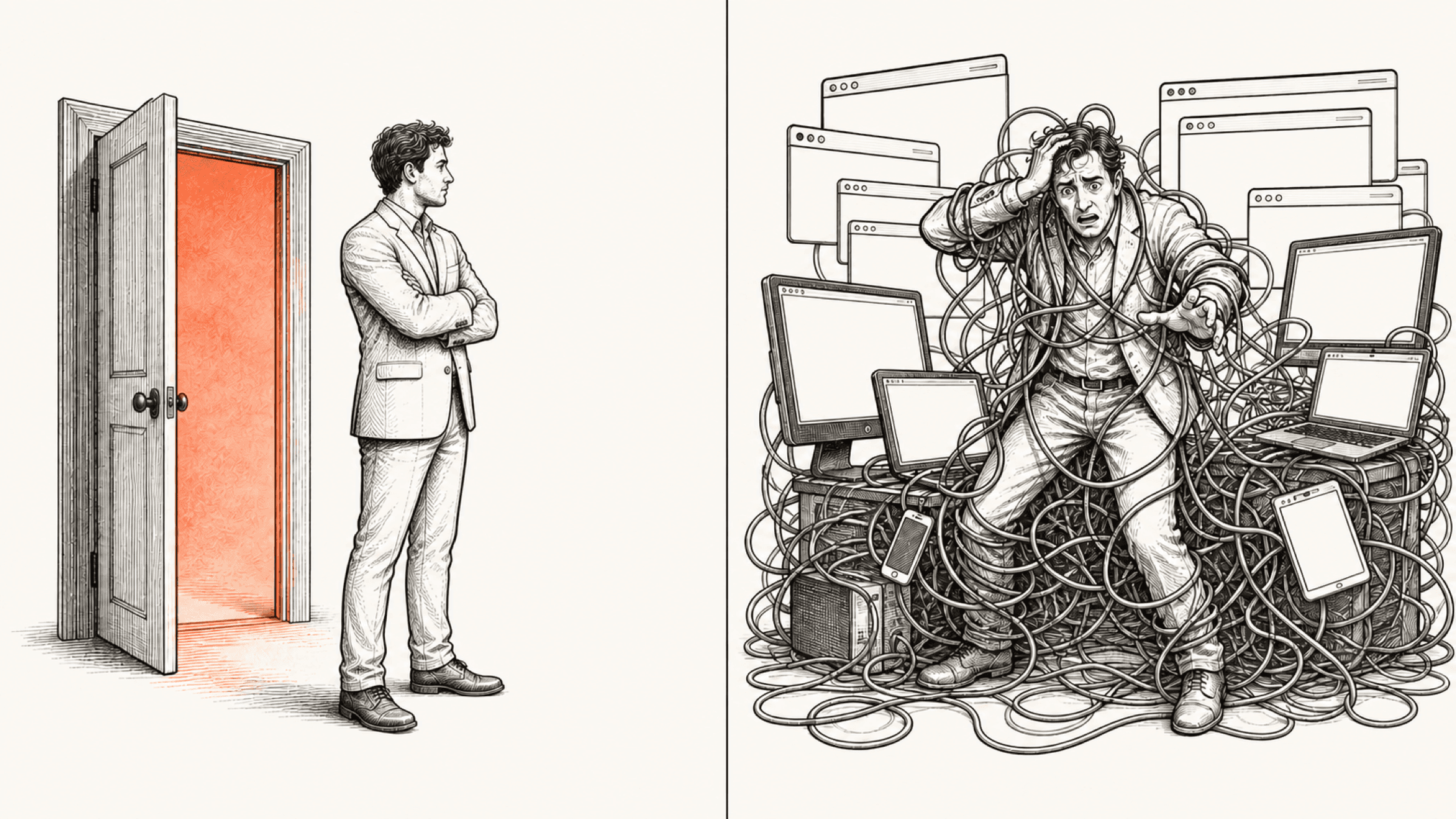 I WANT OFF THIS RIDE
 SHUT UP AND TAKE MY MONEY
Speaker notes · 35s
I am going to move quickly. At some point you may feel like you’re drinking from a firehose.
Your internal monologue may become either ‘I want off this ride’ or ‘I cannot build this. Shut up and take my money.’ Both are valid.
The QR code is on every slide. Scan it once for the presentation, build guide, diagrams and worksheet. You do not need to photograph every slide like you are documenting a crime scene.
Stage cue: Invite the first QR scan here.
Speaker notes · 62s
Quickly, who am I? Because credibility matters, but bios are boring.
I host Canada’s number-one real estate podcast.
I built the Habistat, a data platform used by thousands of REALTORS® every day. The Toronto board liked it enough that they purchased it from us.
I co-own Valery, a real estate brokerage. And most importantly, I still sell real estate.
Showings. Listing appointments. Offers at eleven o’clock at night. I live in the same job you do.
Honestly, I try not to sell too much real estate anymore—but I cannot help it. Inputs to outputs, it remains one of the most efficient ways I know to generate income in this country.
I know the work. I know what it pays. And I know what it costs us in time and attention.
No generated likeness is used. Add an official supplied headshot only if approved.
 Manager
 CMA
CMA CRM
CRM Listings
 Marketing
 Research
 Content
 Offers
 Reports
Speaker notes · 38s
At Valery, we built internal tools for better market intelligence, listings, follow-up, content and operating systems.
Agents outside our brokerage kept asking for access, but did not necessarily want to switch brokerages. So we packaged our data, workflows, templates, automations and processes as software any realtor could use.
That became Homies: the AI team that runs the work behind a real estate business. Today I’m going to show you how we built it. No secrets.
Speaker notes · 62s
Right now, realtors are splitting into two camps. And both camps are making a mistake.
Camp one is ignoring AI and hoping it is a fad. It is not a fad.
Properly harnessed, this is a world-changing force—the same way animal power became a world-changing force once human beings learned to direct it.
Camp two understands that AI matters, but they are spending hundreds of hours becoming amateur software developers.
They are tinkering at midnight. They are six browser tabs deep in tutorials. They have not followed up with a buyer in three days, but they have extremely strong opinions about JSON schemas.
Neither camp wins.
There is a third option: learn enough to understand the harness, build the pieces that make sense for you, and buy back the pieces that are not the highest and best use of your time.
Stage cue: Reveal the two losses separately; leave a beat before the third option.
Speaker notes · 48s
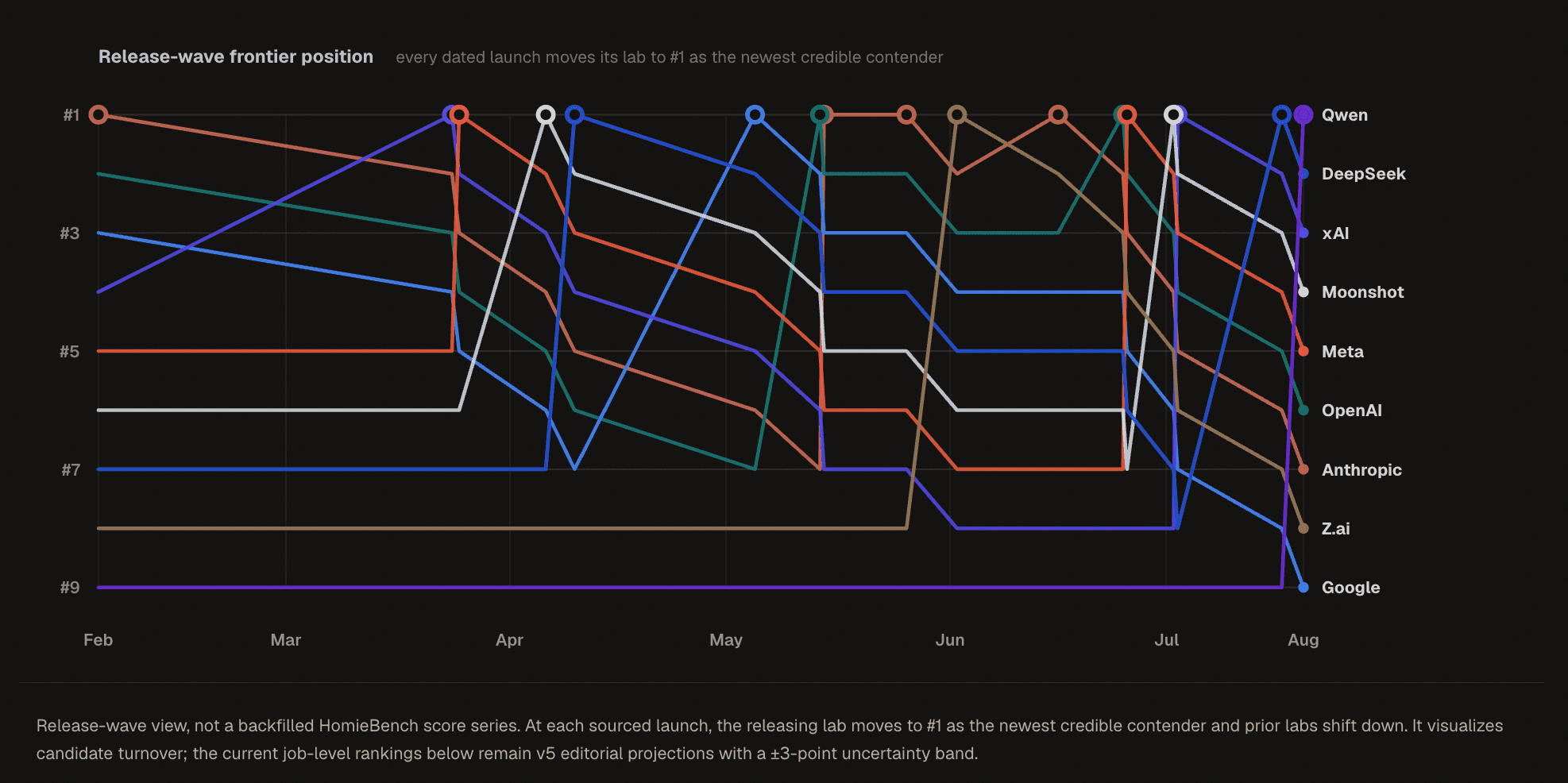
Look at six months of frontier AI releases. The lead does not stay put for long.
The number-one model keeps changing. Your realtor stack should not have to change with it.
A durable harness keeps the business context, tools, permissions, workflows and quality controls stable while the model underneath can be benchmarked and replaced.
This is a release-wave view: each credible launch moves its lab to number one, so the chart visualizes candidate turnover rather than pretending there is one permanent winner.
Release-wave view, not a backfilled HomieBench score series. Current job-level rankings remain editorial projections with a ±3-point uncertainty band.
SWAP THE MODEL.
KEEP THE SYSTEM.
Speaker notes · 72s
Here is another reason the model itself cannot be the product. It feels like there is a new ‘best model’ every week.
A new model launches. It wins a benchmark. Everyone declares the race over. Then seven days later, another horse arrives.
We test these models one by one inside our harness—not on abstract trivia, but on the work of being a realtor.
Build the CMA. Analyze the listing. Draft the client update. Match the properties. Follow the SOP. Use the tools. Recover when something fails.
The best model for a realtor is not necessarily the model at the top of a generic leaderboard. It is the one that performs best inside a real estate workflow.
So we benchmark them in our harness. Today, the winner might be the event-day model. Last month, it was something else. Six months from now, it will almost certainly be something else again.
The model is becoming a commodity in the supply chain. A strong harness should work on multiple horses.
When a better one appears, you do not rebuild the farm. You plug in the new horse, check the benchmark, and carry on with your business.
Stage cue: Update eventConfig.benchmarkWinner on the morning of the event.
The benchmark label is deliberately a live placeholder, not a permanent claim.
Speaker notes · 36s
Here is the entire build: model, access, market, methods, management, channels and server.
Choose the intelligence. Connect it to the business. Give it authoritative market data. Teach it your methods. Manage what it prepares and does. Make it reachable. Then give it somewhere secure and persistent to live.
Seven steps. Simple. The fill-in work between them is where things get interesting.
Stage cue: Reveal the seven numbered steps in sequence.
Speaker notes · 68s
First, choose the horse. Install a frontier AI work application on your actual computer. ChatGPT and Codex. Claude. Pick one.
Do not spend three weeks watching videos debating which model scored two percentage points higher on a benchmark you do not understand. This step should take five minutes.
Congratulations. You now own a horse. Probably a nice show pony. For most people, that is where I recommend starting.
But if you want a cracked-out racehorse that will run as fast as technologically possible toward a goal, with very little concern for the emotional wellbeing of the person riding it, you can experiment with systems such as OpenClaw or Hermes Agent.
Those are powerful horses. Treat them accordingly.
Use narrow permissions. Require approval for consequential actions. Do not connect an experimental agent to every client record, email account, bank account, and contract folder on day one.
OpenClaw-class and Hermes-class agents are advanced examples, not default recommendations. Keep the safety language intact.
Speaker notes · 38s
Connect the AI to the places where your business already lives. Start with one system. Email often contains enormous context: preferences, timelines, commitments and decisions.
Your CRM explains who clients are and where they sit in the pipeline. Your calendar shows what happens next. Files hold templates and historical work.
Without access, every conversation begins from zero. Access gives the system context.
Speaker notes · 32s
An API key is a digital keycard. It lets one piece of software access another. Treat it like an actual key.
Use the narrowest permissions possible. Start read-only when you can. Require approval before anything important is sent or changed.
The goal is a capable assistant, not an all-knowing raccoon with access to your client database.
Speaker notes · 88s
Third, give it access to the market.
A generic model does not know what was listed this morning. It does not know which property reduced its price yesterday. And you should not want it guessing.
In Canada, one approach is Repliers. It takes authorized listing data and makes it available to your AI through an API or MCP connection.
Think of MCP as a universal plug that allows the AI to ask another system a structured question and use the result.
You can also build an authorized connection to CREA DDF.
Depending on your board, brokerage, and software permissions, an agent may also be able to operate your MLS interface through carefully controlled browser automation.
And yes, it can search public listing websites for discovery. But public internet results are not a substitute for authoritative MLS data when you are advising a client.
Respect your board’s rules. Respect data licensing. Respect client privacy. And do not let your assistant invent a listing because it saw something on a stale webpage three weeks ago.
For our American audience, this same layer connects to authorized MLS or IDX data.
Now your AI knows your clients. And it knows your inventory.
The conditional integration announcement remains intentionally omitted until it is public.
Speaker notes · 24s
You have a powerful model. It can see contacts, access the CRM and query real estate data. You are approximately five percent finished.
This is where many demos end. What you have is a very intelligent intern with access to the building and no idea how your business works.
That is not an employee. That is a liability. Now we teach it.
Stage cue: Pause after ‘five percent finished.’
Speaker notes · 112s
This is where it gets real. And where I need to steal a page from Kiyosaki’s Cashflow Quadrant.
Self-employed people own knowledge. Business owners own systems.
The self-employed agent may have 15 years of expertise—but all of it lives in their head and is traded for money one hour at a time.
The business owner has that expertise documented so another human being—or an AI—can run the process.
Step four is to teach the AI your business. But that comes with an uncomfortable footnote: you need to have a business to teach it.
Not only a self-employed job where you are constantly searching for the next buyer or seller who will temporarily become your boss.
That is how most of us begin. There is no shame in it. But you will not experience true freedom until the business can operate without every task passing directly through your hands.
Here is what we have learned from onboarding Homies customers: I could give many agents the best human employee in the world and it would not materially improve their business.
Not because the employee is bad. Because the agent cannot explain what the employee is supposed to do.
The same thing happens with AI. We ask people during onboarding whether they have systems and SOPs. When they do not, we require them to create the first few.
Otherwise, they get very little value from the product, they become frustrated, and we lose them as customers. It is not necessarily our fault. But if we want them to succeed, it becomes our problem.
AI can scale systems. It cannot scale the chaos in your head.
The people who get the fastest results from Homies are the business owners. They paste in their existing SOPs and the system begins executing them.
Speaker notes · 94s
Do not have SOPs? Here is the cheapest fix in this entire presentation. Get Loom—or any screen-recording application.
Do not sit down and invent dummy work. Record real work. The next time you prepare an actual offer, hit record.
Narrate what you are doing. More importantly, explain why.
Why did you select that clause? Why did you exclude that comparable? When should the AI stop and ask you a question? What could go wrong? What does a good result look like?
Then give the transcript to the AI and have it create an SOP, a checklist, a list of required inputs, a template, a list of exceptions, and a quality-control rubric.
Do that once a day for a month and you will have something most agents never build: a business operating system.
That is valuable whether you purchase Homies or never touch an AI product again.
Or you can skip much of that initial work. We preloaded Homies with the systems from my business and workflow patterns contributed by the hundreds of realtors who helped us develop the product.
But I promised you the entire recipe. So this is how you begin building it yourself.
Speaker notes · 96s
Now you put it to work.
Follow-ups. CMA drafts. Booking showings. Creating recurring tasks. Updating sellers every week with listing statistics—because properties can sit on the market for 60 days now, and clients still expect to know what is happening.
Your job changes. You are no longer completing every administrative step. You become quality assurance.
Review. Score. Correct. Save. Repeat.
You become the manager of one very fast, slightly overconfident employee.
And here is what can make this different from every assistant you have trained: every correction can become permanent. But only when you save it into the harness.
Save it to the SOP. The example library. The checklist. The template. The approval rule. The quality rubric.
Then tomorrow’s run begins where today’s ended. The assistant does not quit and take all of the training with it.
But be precise about this: correcting one answer inside one chat does not magically retrain the underlying model.
If you correct the answer and close the conversation, you may have taught it nothing. The compounding occurs when the harness preserves the correction.
Speaker notes · 62s
There is also a bonus step. Make the harness reachable when you are not sitting at your desk.
Claude channels. Codex channels. OpenClaw channels. Or something as simple as texting your CRM phone number, which sends a secure webhook back to the harness.
Imagine texting: ‘Prepare tomorrow’s showing tour.’
The system finds the appointments. Organizes the route. Places every property address into the calendar location field. Builds the client itinerary. Creates your showing cheat sheet. And sends everything back for approval.
The harness should not be trapped behind your desk. It should meet you where the work happens.
But the same rule applies: authenticate the user, limit the available actions, and retain approvals around anything consequential.
Stage cue: Optional in the 20-minute deck. Cut from the 10-minute version.

Speaker notes · 62s
Seventh, give the harness somewhere safe to live.
If it relies exclusively on your everyday laptop, every time you close that laptop, the worker disappears.
A persistent harness needs a safely configured, always-on environment: a dedicated machine, a virtual machine, or a cloud server.
The point is not a giant computer. The point is a stable environment that is reliably available and separated from your personal digital life.
Give it only the accounts, files, tools, and permissions it actually needs. Store secrets securely. Keep logs. Apply updates. Maintain backups. Give yourself an emergency off switch.
Put the horse in a secured field. Do not leave it unattended in your living room.
Stage cue: Land the secured-field callback, then move into the Homies team.
Mac mini image: Apple Newsroom. A dedicated Mac is one deployment option; a secured VM or cloud server can serve the same role.
ManagerCMACRMListingsMarketingResearchContentOffersReportsSpeaker notes · 40s
The Manager Homie is the front door. You brief it once. It identifies the work, delegates to specialists and brings the finished work back for review.
The bench covers CMA, CRM, listings, marketing, research, content, offers and reports. One manager. A bench of specialists. All connected to the same business.
MANAGERCRMResearchCMAListingsMarketingReportsContentSpeaker notes · 58s
The CRM Homie finds the seller history and outstanding promises. Research gathers property, neighbourhood, school and market context. CMA builds comparables and pricing strategy.
Listings creates the checklist and future description. Marketing builds the launch plan. Reports assembles the branded presentation. Content drafts the seller message.
The Manager returns the package, flags missing information and asks for the three decisions that still require judgment.
One goal. Multiple specialists. Connected data. Finished work. Human review.
Stage cue: Let the workstreams animate out from Manager.
Speaker notes · 98s
Here is what ours does today. Do not take notes. The QR code has everything.
Detailed CMAs for purchases, sales, and leases. Offer drafting. The paperwork completed and prepared for signature.
Thoughtful, personalized buyer lists—not the same automated MLS dump sent at midnight every night until the client unsubscribes from your existence.
Listing profiles. Listing websites. Showing tours booked.
Google Calendar invitations sent to you and your clients—with the property address placed in the actual location field so everyone can tap it and navigate.
A secure showing cheat sheet with property details, showing instructions, appointment information, and authorized access notes so you are not standing in a driveway searching through seven email threads.
Follow-up written in your voice. A CRM that updates itself. Weekly seller updates with listing statistics.
YouTube videos turned into short-form clips. Branded social carousels. Market reports. Neighbourhood research with the claims sourced.
Client emails. Calendar management. Recurring tasks. Important dates diarized automatically. Valuations. Property comparisons. Presentation decks. And dozens of other workflows.
In our internal workflow audit, the harness can automate or AI-assist roughly 80 to 90 percent of the repeatable, computer-based administrative steps surrounding a real estate transaction.
That does not mean it replaces 80 to 90 percent of the value of a realtor. It means it can remove most of the machine work surrounding the realtor.
Almost everything a human being does at a computer in this industry can at least be assisted by a properly built harness.
The judgment, accountability, relationships, and client trust still belong to you.
Stage cue: Let capabilities cascade quickly until the screen feels intentionally overwhelming.
The 80–90% figure refers only to repeatable computer-based administrative steps in an internal workflow audit—not realtor value or whole jobs.
Speaker notes · 36s
Authentication, permissions, field mapping, webhooks, rate limits, retries, schemas, prompt versions, failures, logging, privacy, compliance, cost controls, approvals, exceptions and testing.
The recipe is seven steps. The implementation is thousands of decisions.
The steps are simple. The work between the steps is the product.
Stage cue: Accelerate the term cloud, then cut to silence for the reveal.
Speaker notes · 118s
Could you build all of this yourself? Yes. Absolutely.
I just gave you the recipe and held nothing back. This is a smart room. Chances are, many of you could figure it out.
We actually encourage people to try. The more someone understands what is required to build a reliable harness, the easier our product becomes to sell.
Here is why I am comfortable sharing the secret sauce: the secret sauce is not secret. It is work.
It took me—obsessed with this stuff and surrounded by engineers—about two months to get the system to ‘pretty good.’
Then it took our developers more than six additional months to make it something I would trust around real client work. And we still improve it every day.
The question is not whether you can build it. The question is whether the time required to build a good one is worth more than the price of the existing product.
Just because you can do something does not mean you should.
I can install my own flooring and trim. I do not. Not because I am incapable. Because I can do more profitable things with my time—and my wife will kill me if I start another DIY project in our house.
Some of you should build the harness. If you love tinkering, do it.
If you want to understand every stud, wire, connection, permission, and failure state, it is a hell of a journey and you will become better because of it.
But for most people in this room, your most valuable hours are spent with buyers, at listing appointments, negotiating deals, creating content, building your brand, leading your team, and being present with your family.
They are not spent debugging a CRM sync at midnight.
The steps are simple. The work between the steps is the product.
Stage cue: Reveal YES. Then reveal SHOULD YOU?

Speaker notes · 43s
The E-Myth taught systems. The Millionaire Real Estate Agent taught leverage. Buy Back Your Time taught delegation. Cashflow Quadrant taught moving from operator to owner. The books were right.
What changed is the economics. Repeatable digital tasks can now be executed for pennies per task.
Not judgment, accountability or relationships. The repetitive keyboard-and-browser layer. That gives humans more time to listen, negotiate, advise, reassure, create trust and make hard judgment calls.
Speaker notes · 28s
AI’s greatest advantage is not simply what it can do today. It is what happens as the system improves tomorrow, and the day after that.
Health, investments, real estate, knowledge, relationships, trust and data compound. AI systems compound too, when you deliberately preserve what they learn.
Speaker notes · 48s
One workout does not change your life, but each workout builds capacity on the last. You become strong through consistency.
Real estate compounds through principal paydown, appreciation, income growth, improvements and accumulated experience. The sooner you start, the more time the asset gets.
One month of price reductions tells you something. Ten years gives you a baseline to compare cycles and detect anomalies. A data point is trivia. A time series is intelligence. History makes the present legible.
Speaker notes · 92s
AI follows the same compounding law.
Every saved prompt. Every SOP. Every example. Every correction. Every integration. Every automation.
Each one becomes a building block for the next capability.
And people will say: ‘But AI gets things wrong.’ Of course it does. So does every new employee.
I have never hired an administrator who arrived on their first day understanding our entire business and producing perfect work.
If a new hire completed 70 percent of the job correctly on day one, I would think I had hired a unicorn.
We train people. We give them examples. We correct their work. We explain the exceptions. We show them what ‘good’ looks like.
The difference is that a well-built harness can preserve that training.
The employee may eventually leave and take years of accumulated context with them. The documented system remains.
That does not mean the AI is automatically correct. It means tomorrow’s result can begin with today’s learning—provided you captured it.
Every day you use the harness, you become better at directing it. Every day you improve the harness, it becomes better at working for you.
That is the compounding.
Speaker notes · 47s
One percent better once is almost invisible. Compounded over 365 repetitions it becomes 37.78 times the starting point.
That is mathematics, not a promise that your GCI grows 37 times. Business is uneven and experiments fail. The principle is that tiny improvements stop being tiny when repeated and preserved.
A practical target is one workflow per week. At year end, you do not have one dramatic transformation. You have 52 working systems.
Illustrative compounding model: 1.01ⁿ. Real business growth is uneven and non-linear.
Speaker notes · 48s
Open Notes and finish that sentence. Whatever goes in the blank is your first automation candidate.
Your frustration may be your nervous system identifying a badly designed workflow. Look for work that is dull, digital, defined and done often.
Write down the trigger, required information, definition of a good result and the human approval point. You do not need a comprehensive AI strategy. You need one clearly delegated task.
Stage cue: Give the room 20 quiet seconds to write.
Speaker notes · 98s
If you found this overwhelming, good. This shit overwhelms me, and I live in it every day beside engineers building things that change how I work and live.
The future is scary, intimidating and uncertain because of AI. It is also almost unlimited because of AI.
On the other side of fear: more time, money, better results, happier clients, less stress, more focus and more attention for what matters.
Zero to one hundred from a dead stop would be reckless. No one is asking for that jump. There is a staircase. Take one step.
Some of you are going to leave this room and build the whole thing. Good.
We know how difficult that journey is, and we genuinely encourage it. You will understand the technology more deeply. You will understand your own business more deeply.
And frankly, after you have spent a few evenings dealing with APIs, permissions, expired tokens, broken webhooks, and a racehorse that tried to email every contact in your database, our pricing is going to look extremely reasonable.
But whichever path you choose, the assignment is the same:
Do not leave here at zero.
Build it yourself. Begin with Homies. Use another product. I do not care which logo is on your first step nearly as much as I care that you take it.
Stage cue: Stage-safe alternate: ‘This stuff overwhelms me.’ Pause after the pricing callback, then advance to the staircase.

Speaker notes · 56s
Leave this presentation one percent better. Take one thing you learned today and delegate one part of it to an AI assistant now, not tomorrow.
If you want that assistant to be Homies, we would love to have you. If you would rather build it yourself, do it. Maybe you love tinkering. Just start.
You do not need to see every step. Take the first one. Or scan the code for a 30- or 40-step head start. Build it or buy it, but do not stand still.
Stage cue: Make the QR code the largest object after the staircase.
Event pricing is intentionally hidden until plan names, prices and expiry are confirmed.
Speaker notes · 22s
AI is the horsepower.
Your systems are the harness.
Your first step is today.
Harness it.
Stage cue: Reveal in three beats. Pause. Walk off. Add nothing.
One-page handout
Non-stage appendix
Historical and product claims are intentionally qualified. Pricing and unannounced partnerships are not published in this deck.