Real Estate AI Is Moving Into Contracts and Daily Work
Realtracs and Zillow are accounting for AI in listing-data contracts while Compass is measuring how agents use AI across the platform. Together, they show real estate AI becoming infrastructure.
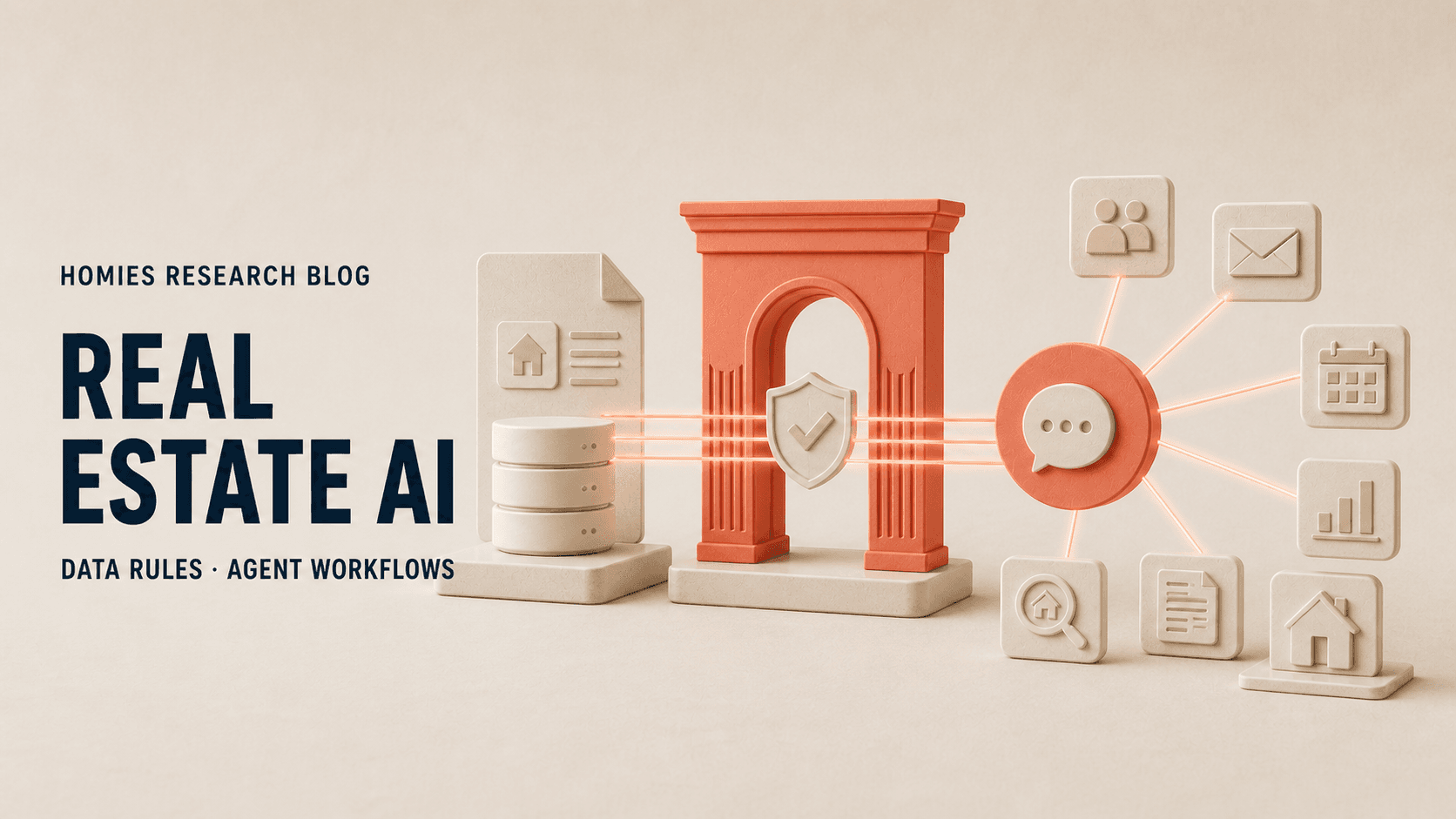
Data rules
Realtracs and Zillow cite AI guardrails in a new licensing agreement
90+ tools
Compass AI Assistant connects prompts to platform capabilities
97,000+ conversations
Approximately 15,000 Compass agents generated early activity
The shift
Two real estate AI signals point to one structural change
Two announcements in the same week show artificial intelligence moving into the operating infrastructure of real estate. One concerns the rules governing listing data. The other concerns how agents reach the tools they use every day.
Realtracs and Zillow provide the governance signal: their updated data licensing agreement explicitly recognizes emerging technologies, including AI. Compass provides the adoption signal: its integrated AI Assistant is being used as a natural-language interface across more than 90 platform tools.
The combined signal
Contracts are starting to define what real estate AI may do, while platforms are measuring what agents actually do with it.
Signal one · Data governance
Realtracs and Zillow put AI into listing-data licensing
On August 5, 2026, Zillow announced an updated agreement with Realtracs, the multiple listing service serving Nashville and markets across Tennessee, Kentucky, Alabama, Georgia, North Carolina, and South Carolina. Zillow says the licensing standards add guardrails for responsible uses of listing data in emerging technologies, including artificial intelligence.
That is meaningful evidence for MLS operators, real estate boards, associations, and brokerages. Traditional data agreements focused on access, display, attribution, timeliness, and redistribution. AI introduces additional questions about automated analysis, generated property content, model training, data retention, and derived outputs.
The detailed guardrails have not been published, so the announcement does not prove that Realtracs and Zillow agreed to any particular training restriction, payment model, or technical control. What it does prove is that AI use is entering the licensing conversation.
Read Zillow’s original Realtracs data licensing announcement .
Signal two · Agent workflows
Compass is making AI the front door to its real estate platform
In its August 4, 2026 results, Compass said its integrated AI Assistant had been broadly demonstrated in early July. It enables more than 90 platform tools to be reached through natural-language prompts. Compass also reported that approximately 15,000 agents had generated more than 97,000 conversations.
90+
platform tools
~15K
agents
97K+
conversations
Compass describes the assistant as a conversational layer across its Home Platform. Published examples include updating CRM records, drafting follow-up emails, creating saved searches, managing transactions, finding likely-to-sell opportunities, and scheduling reminders. The architectural change is simple but important: the agent asks for an outcome instead of navigating every tool separately.
See the primary Compass Q2 2026 results and Compass AI Assistant product announcement .
Reading the evidence
Governance and engagement are milestones—not the finish line
The Realtracs–Zillow announcement shows that AI is being recognized in a data license, but it does not disclose the underlying permissions or restrictions. Compass’s numbers show reach and repeat interaction, but conversations alone do not establish accuracy, completed work, time saved, client satisfaction, revenue impact, or return on investment.
Real estate leaders should now look for evidence on both sides of the system:
- Permitted AI use: which agent, consumer, analytics, and automation experiences may use listing data?
- Model and data rights: may information be retained for training, evaluation, retrieval, or product improvement?
- Task completion: what share of AI-requested workflows finish reliably without manual recovery?
- Business outcomes: does adoption improve response time, appointments, transactions, or client experience?
For boards, MLSs and brokerages
The practical AI checklist now spans contracts and operations
A real estate board or MLS can translate AI policy into its data agreements by defining permitted uses, model-training rights, retention limits, derived outputs, security requirements, audit access, deletion obligations, and enforcement. A brokerage can apply the same discipline operationally through permissions, human approval, task-level logs, error recovery, and outcome measurement.
This is especially relevant for Canadian boards evaluating AI vendors. Governance should not live only in an ethics statement, and adoption should not be measured only by prompt counts. The rules need to follow the data; the evidence needs to follow the work.
Source note
The separate 6,000-hour claim is about another Compass
A Renascence article attributes 6,000 staff hours saved through AI voice support to Compass, the real estate brokerage. The primary source does not support that attribution. TTEC Digital identifies the customer as Compass Working Capital, a separate nonprofit financial-services organization, and describes 6,000 hours as expected annual savings—not a reported result from Compass, Inc.’s AI Assistant.
Attribution matters
The 6,000-hour metric should not be presented as a Compass real estate AI result.
Compare the Renascence summary with the TTEC Digital primary announcement .
Bottom line
Real estate AI governance and adoption are moving in parallel
Realtracs and Zillow show AI moving into the contracts that govern listing data. Compass shows AI moving into the daily interface agents use to reach real estate software. These are not separate stories: one defines the boundaries, and the other tests the behaviour inside them.
The next durable advantage will come from connecting both—clear data rights and controls paired with reliable workflows and measurable results.