CREA Just Opened the DDF Door to AI—Carefully
The updated DDF terms let REALTOR.ca listing content power opt-in AI augmentations for the first time—and set Canada's first explicit no-training rule for MLS data. What changed, and what still has not.
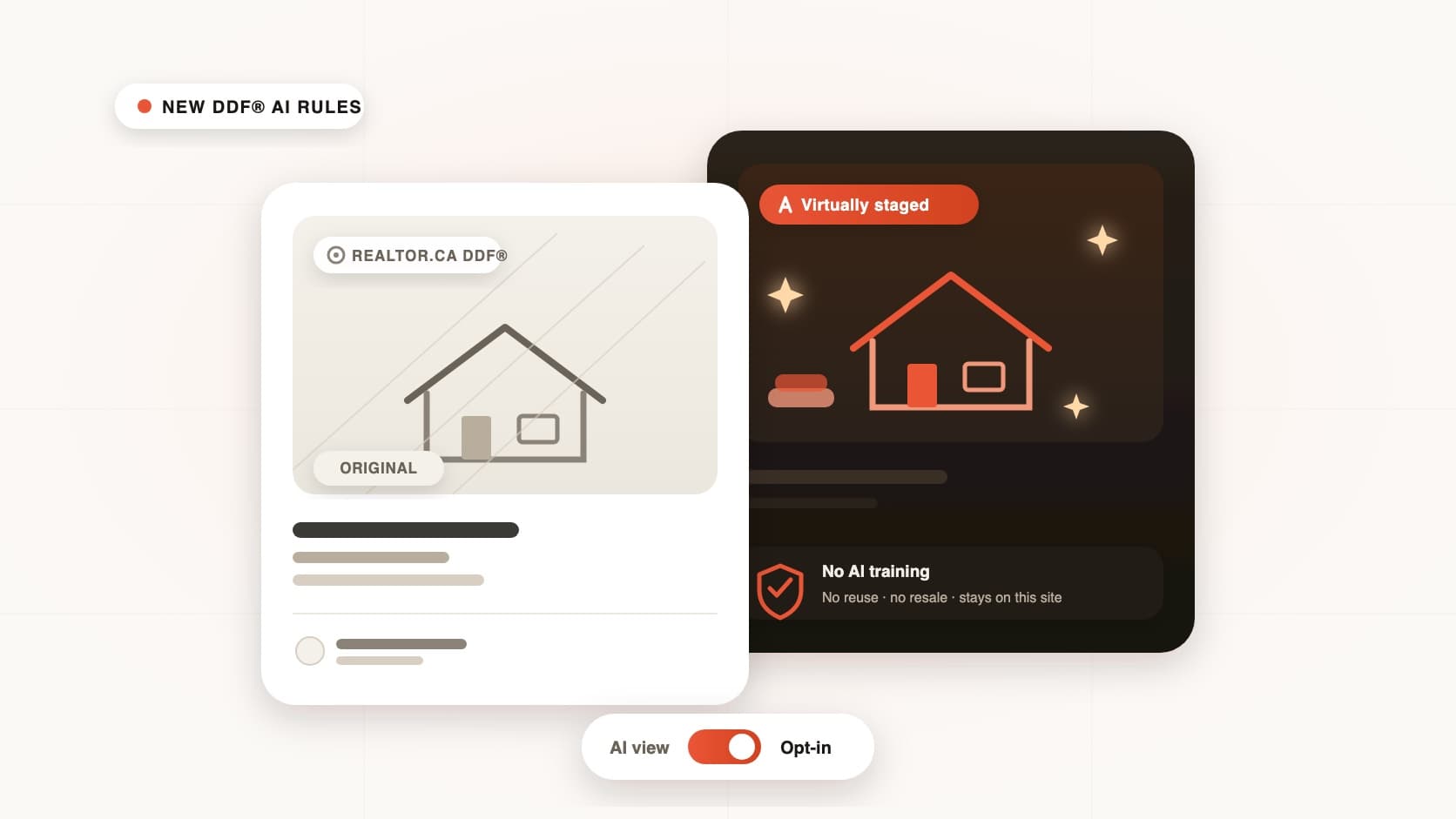
What changed
AI, AR, and virtual staging tools are now permitted on DDF listing content, under strict safeguards.
The hard limits
No model training, no reuse, no off-platform hand-offs. Original content first, opt-in overlays, clear labels.
The open gap
Display rules arrived; agentic access rules—queries, custody, audit—still have not.
Planning and legal notice
This note is analysis of publicly announced CREA policy, not legal advice. DDF® terms, board rules, and MLS® policies change and vary by jurisdiction, and the notice we reviewed carries no stated effective date. Verify the current agreements with CREA, your board, and your brokerage before building or buying listing-data AI features.
The update
CREA is writing AI into the DDF for the first time
In August 2026, CREA notified members of a change to the DDF® terms and conditions that, for the first time, explicitly permits DDF participants to offer artificial intelligence, augmented reality, virtual staging, and similar tools on listing content. Since its launch in 2012, the DDF—the national, permission-based feed that powers listing display across members’ and partners’ websites—has been display-only by rule: no derivative use, no redistribution, active listings only, watermarks on. It had no written answer to the question every technology provider has been asking since 2023: can an AI touch this data at all?
The answer is now a conditional yes. The update introduces a defined concept CREA calls an augmentation: a visual, informational, or interactive enhancement shown using technology—virtual staging, paint-colour visualization, renovation renderings, AI- or AR-generated views—delivered as an alternate presentation a consumer can choose to see. The permission comes paired with safeguards stricter than most US MLSs have published, and it lands alongside CREA’s broader position on AI , which anchors REALTOR® use of AI to transparency, accuracy, and accountability—and to the existing advertising articles of the REALTOR® Code (Articles 13 and 15).
1st
To our knowledge, Canada's first explicit national no-AI-training rule for MLS listing data.
2012
The year the DDF launched as a display-only feed. 2026 is the year AI entered its rules.
Opt-in
Augmentations must be user-activated overlays; the original listing displays first and by default.
100%
Share of third-party AI provider compliance the DDF participant remains responsible for.
The timing detail worth knowing: the notice circulated to members carries no announcement date and no effective date, and the most recent publicly posted DDF Policy and Rules document still shows a January 2024 revision. The safeguards below are the design target; confirm timing with CREA and your board before shipping.
The safeguards
The augmentation rules, in plain language
The updated terms hang together as one design pattern: the original listing is the record, and anything an AI produces from it is a labelled, temporary, revocable view. Eight requirements do most of the work.
Original-first display
The unmodified listing content must display first and by default. An augmentation can never be the landing state, and users must always be able to return to the original on the same site.
Active opt-in
Consumers must choose to enable an augmentation. Auto-activated AI views are not permitted.
Temporary overlay
Augmentations are user-controlled overlays or alternate views. The original content stays unchanged and available.
Prominent labelling
Enhanced views must be clearly and prominently labelled while shown—“virtually staged,” “AI-generated visualization,” and equivalents.
No training, no reuse
DDF listing content cannot train an AI system. Providers may not reuse it for another purpose, sell it, distribute it, use it to improve another product, or acquire any separate licence to it.
Provenance intact
An augmentation must not hide, remove, alter, or diminish watermarks, brokerage information, attribution, or required disclosures—and augmented content must not be downloadable or republishable.
Stays on your site
Participants cannot send a user and the listing content out to a separate public AI website or app. The augmentation must remain part of the participant's own website or application.
Enforceable
Boards, associations, and REALTOR.ca Canada Inc. can require a feature to be changed or removed, and can suspend or terminate DDF access or specific functions.
Responsibility is assigned just as clearly. Participants must either build augmentation functionality themselves or use third-party technical providers—CREA and REALTOR.ca provide no augmentation tooling of their own—and participants carry full responsibility for those providers’ compliance, on top of existing board, association, MLS®, advertising, and co-branding rules. If a vendor’s virtual-staging model quietly trains on the photos it processes, that is the participant’s problem, not an abstraction.
One more reading note: the training prohibition is categorical. It does not distinguish fine-tuning from retrieval indexes built for other purposes, and it explicitly bars content from being used to improve any other product. Providers should assume any persistent secondary use of listing content is out of bounds until CREA says otherwise.
Read the silence
This is a display rule, not an access rule
Everything in the update governs how AI may present listing content to a consumer on a participant’s website. Almost nothing in it governs how AI systems may work with listing data—which is where the real questions in agentic real estate live. The update is silent on:
- Agentic queries: whether an AI assistant may run bounded listing searches against DDF data on a realtor’s behalf, and under whose credentials.
- Custody: whether raw feed content may enter a model’s context window at all, or must stay inside an approved participant application.
- Derived work: CMAs, market statistics, and pricing analysis built from feed data—long restricted under the display-only baseline, and not revisited here.
- Identity and audit: how an AI acting for a member is identified, logged, rate-limited, and revoked.
- Write paths: showings, offers, and transaction actions that touch board systems—out of scope entirely.
None of this is a criticism of the drafting. Virtually staged photos and AI-enhanced media were the live consumer-facing issue—by May 2026, one study of roughly 72,000 REALTOR.ca listings estimated that about 37% of Canadian listing descriptions were likely AI-written—and CREA addressed the presentation problem with unusually clean mechanics. But technology providers should not read the update as permission for AI listing search, AI market analysis on feed data, or agent-to-agent workflows. Those remain governed by the existing permission-based DDF agreements and board rules—which is to say, mostly ungoverned by anything written for AI.
The standard we keep pointing at
One step toward LAIRE. Several to go.
Our LAIRE framework (formerly RAILS) argues that safe agentic AI in real estate needs capability without custody: the approved participant application holds the credentials and executes queries server-side, while the AI receives schemas, bounded tools, opaque references, and rendered results with provenance. Measured against that standard, the DDF update covers the presentation layer—labelling, provenance, original-first display—and stops there.
That makes it a genuine step in the right direction. The no-training rule is custody thinking. The overlay-not-replacement rule is provenance thinking. The participant-responsibility rule is accountability thinking. What is missing is the access layer LAIRE specifies: agent identity, permissioned query tools, server-side execution, audit trails, and revocation. Until CREA writes those rules, every Canadian AI product that goes beyond presentation is building on interpretation rather than policy—and the conservative interpretation is the only defensible one.
Why now
The direction of travel: a for-profit REALTOR.ca is coming for AI
The rules change makes more sense against the corporate backdrop. REALTOR.ca became REALTOR.ca Canada Inc. in January 2025—a wholly owned, taxable, for-profit CREA subsidiary, approved by 77% of members voting—precisely so it could pursue product and revenue moves a not-for-profit could not. In January 2026 it hired a CEO from Kijiji with a track record of shipping AI features, and announced an RBC partnership that both sides say will grow into AI-enabled tools on RBC’s data and analytics.
Yet as of August 2026, REALTOR.ca has shipped no consumer AI feature—while its US counterpart Realtor.com launched an AI search assistant in June. Read together, the sequence looks deliberate: write the data rules first, ship the AI second. The DDF update is CREA laying the legal groundwork for AI on the national platform before anything user-facing exists—presentation rules now, with the harder access rules still to come. For Canadian realtors and proptech builders, that is the signal: the national platform is preparing for AI in public, one layer at a time.
For members and builders
What to do with this now
If you are a realtor: expect virtual staging, AI photo enhancement, and similar features to start appearing on DDF-powered websites—legitimately. Hold your vendors to the safeguards: original-first, opt-in, labelled, no training, nothing routed off-platform. If a tool cannot show you its labelling and its data-use terms, it is not compliant, and under the updated terms the compliance failure lands on the participant side, not just the vendor’s.
If you build technology: the update gives you a clean specification for presentation features and a clear red line on data use. Build augmentations as stateless transforms—content in, rendered view out, nothing retained, nothing trained. Keep anything agentic—search, analysis, actions—behind an approved application boundary with the LAIRE access pattern, and paper your provider agreements so a participant can demonstrate your compliance to their board on demand.
The organizations that will benefit when the access rules arrive are the ones already operating as if they existed.
Questions
Frequently asked questions
Can AI tools now use REALTOR.ca DDF listing data?
In a narrow way, yes. CREA's updated DDF terms let participants offer AI, augmented reality, virtual staging, and similar enhancement tools on top of listing content—provided the original listing displays first and by default, the enhancement is an opt-in, temporary, clearly labelled overlay, and all watermarks, brokerage identification, and disclosures stay visible. The augmentation must also stay inside the participant's own website or application.
Can DDF listing content be used to train an AI model?
No. The updated terms state that DDF listing content cannot be used to train an AI system—to our knowledge, Canada's first explicit national no-training rule for MLS listing data. Third-party AI providers may process content only as needed to deliver the specific augmentation, and may not reuse it, sell it, distribute it, use it to improve another product, or acquire any separate licence to it.
What counts as an augmentation under the new DDF terms?
A visual, informational, or interactive enhancement shown using technology: virtual staging, paint-colour visualization, renovation renderings, AI- or AR-generated views. It must be delivered as a user-controlled alternate view, labelled clearly (for example, “virtually staged”), must never replace the original content, and must not be downloadable or republishable.
Can a listing site send users to ChatGPT or another public AI app with the listing?
No. The terms address this directly: the augmentation must remain part of the participant's own website or application. Routing a consumer and the listing content out to a separate public AI website or app is not permitted.
Do the new rules let an AI assistant query DDF data or act on it?
No. The update governs how AI may present listing content to a consumer. It does not define how an agentic AI system may query listing data, hold credentials, execute searches, or take actions—the capability-and-custody questions the LAIRE framework addresses. The DDF's baseline remains display-only, permission-based distribution.
Who enforces the new DDF AI rules?
The participant's board or association, and REALTOR.ca Canada Inc., can require a non-compliant feature to be changed or removed, and can suspend or terminate DDF access or specific functions. The participant carries full responsibility for third-party provider compliance, on top of existing board, MLS, and advertising rules.
When do the new DDF AI terms take effect?
CREA's change-of-terms notice, circulated to members in August 2026, does not state an effective date, and the most recent publicly posted DDF Policy and Rules document still carries a January 2024 revision date. Treat the safeguards as the design target now and confirm timing with CREA and your board before shipping augmentation features.
Does REALTOR.ca itself have an AI search feature?
Not as of August 2026. REALTOR.ca Canada Inc.—the for-profit CREA subsidiary formed in January 2025—has signalled AI ambitions, including through its 2026 RBC partnership, but has shipped no consumer AI feature yet. In the US, Realtor.com launched its RealAssist AI search assistant in June 2026, a useful preview of where portals are heading.