CREA’s AI Guidance: Transparency, Accuracy, and Accountability, in Code
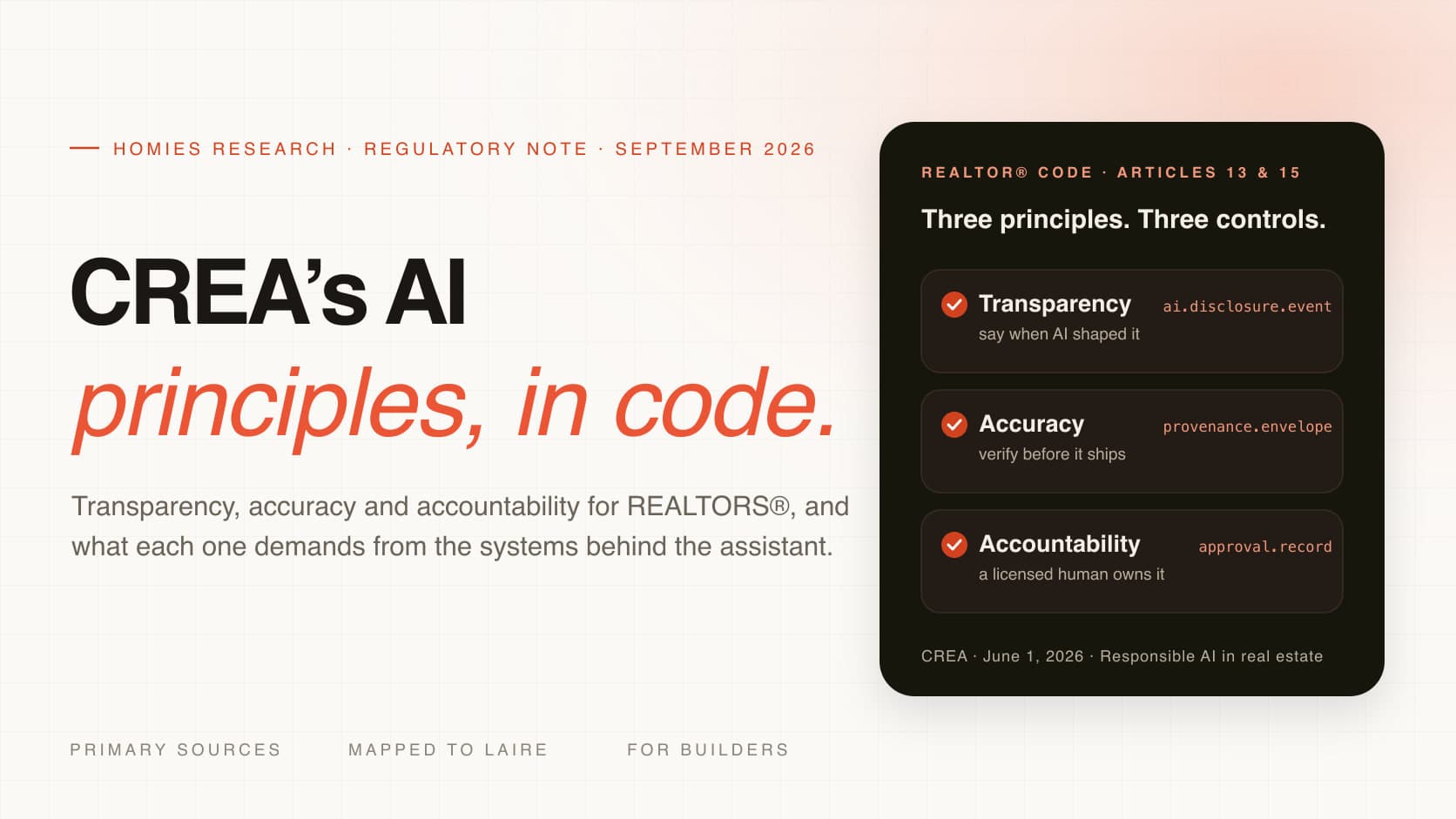
The Canadian Real Estate Association’s AI principles fit in three words. Each one is a requirement on the software behind the REALTOR®, not just on the REALTOR®.
What CREA said
AI use must be transparent, accurate, and accountable, and adoption does not alleviate a REALTOR®’s professional responsibilities.
Where it binds
Articles 13 and 15 of the REALTOR® Code, the DDF® AI terms, provincial regulators, privacy and human rights law, and the Competition Act.
What it means technically
Disclosure events, provenance on every claim, and a licensed human’s exact-version approval before anything consequential ships.
Planning and legal notice
This note analyses public CREA, regulator, and government material as of September 3, 2026. It is not legal advice. Provincial rules differ, CREA says its AI resources are still in development, and board and MLS® policies change. Confirm current obligations with CREA, your provincial regulator, your board, and counsel before relying on any reading here.
The statement
CREA chose principles over rules, and said why
On June 1, 2026 the Canadian Real Estate Association published CREA Supports Responsible AI Use in Real Estate and a standing Artificial Intelligence page . The document is short. It says the use of AI must be guided by transparency, accuracy, and accountability; that consumers and REALTORS® should clearly understand when AI is materially influencing information, communications, or representations; that the adoption of AI does not alleviate the professional responsibilities of REALTORS®; and that REALTORS® remain fully accountable for the information, advice, and services they provide. It points to two existing articles of the REALTOR® Code, commits CREA to working with boards, associations, industry partners, and REALTOR.ca, and promises resources and best practices to come.
CEO Janice Myers framed it as balance: innovation must be balanced with responsibility, and CREA’s job is to help REALTORS® adopt AI confidently in ways that match the standards Canadians expect. Chair Garry Bhaura added the point that will matter most in disputes: the human expertise, professional judgment, and accountability REALTORS® provide remain essential. Neither quote is anti-technology. Both are anti-abdication.
3
Principles: transparency, accuracy, accountability. No new rule, no exemption.
Art. 13 & 15
The REALTOR® Code articles CREA cites: advertising content and accuracy, and advertising claims.
~37%
Share of Canadian listing descriptions one May 2026 study of roughly 72,000 REALTOR.ca listings estimated were likely AI-written.
Aug 2026
CREA’s DDF® terms change: opt-in, labelled, original-first AI augmentations and a categorical no-training rule.
Why principles instead of rules? Partly jurisdiction: CREA writes the Code and runs REALTOR.ca, but licensing and discipline belong to the provinces. Partly timing: the tools change monthly and a rule written for chatbots in 2024 would already miss agentic systems that act. Principles that attach to existing Code articles age better, and they leave room for the specific rules CREA controls, which arrived two months later in the DDF®.
The principles
Three words, each with a technical meaning
Most coverage of the CREA statement treated it as advice to agents. We think it is better read as a requirements document, because a REALTOR® cannot personally deliver transparency, accuracy, or accountability for output generated by software they do not control. The software has to make each principle possible.
Transparency
CREA: Consumers and REALTORS® should clearly understand when AI materially influences information, communications, or representations.
In code: The system must know, at the moment of output, whether AI materially shaped it, and must be able to say so to the consumer and record that it did.
Accuracy
CREA: Advertising content, claims, and communications must be accurate whoever drafted them.
In code: Every factual claim needs a source in a system of record and a data-as-of time. Free-form generation without verification is not an accuracy control; provenance is.
Accountability
CREA: REALTORS® remain fully accountable for the information, advice, and services they provide.
In code: A named licensed human must approve the exact artifact before it reaches a client, and the approval must be recorded in a way that survives an audit.
The word doing the most work is materially. CREA did not say every spell-check must be disclosed. It said the consumer should understand when AI is materially influencing what they are told. That is a judgment, and judgments need inputs. A system that cannot tell the difference between correcting a typo and inventing a comparable sale cannot support the REALTOR® in making it. The technical answer is to classify influence at generation time: drafted, summarized, calculated, recommended, or merely formatted. The disclosure decision then has something to run on.
The Code
Articles 13 and 15 already cover AI, which is the point
CREA did not write an AI article into the REALTOR® Code. It pointed at two that exist. Article 13 governs advertising content and accuracy; Article 15 governs advertising claims. The message to members is that an AI-written listing description, neighbourhood summary, or market claim is advertising like any other, and the REALTOR® who publishes it answers for it under the same standard as a description they typed themselves.
This mirrors NAR’s approach south of the border, where Article 2 of the Code of Ethics (no exaggeration, concealment, or misrepresentation of pertinent facts) is cited as the rule for AI-enhanced content, and it mirrors the regulators. Canada’s Competition Act prohibits false or misleading representations to promote a product or business interest; provincial real estate rules, from BCFSA’s Rules sections 40 and 41 to Ontario’s TRESA advertising requirements, prohibit false or misleading advertising. None of them contain an AI carve-out. CREA is telling members what the regulators would tell them anyway: the tool changes the workflow, not the duty.
The practical consequence for listing content is a verification loop. A description that says renovated kitchen, steps to transit, or lowest price on the street is a claim, and the REALTOR® must be able to substantiate it. That means the AI drafting it should be pulling facts from the listing record, the board’s data, or the REALTOR®’s own notes, and flagging anything it could not source. Fluent prose with invented facts is the single most common way an AI puts a REALTOR® offside Article 13, and it is entirely preventable at the system level.
The rule stack
No AI statute, many AI rules
Canada has no AI-specific law in force. The federal Artificial Intelligence and Data Act died with the 2025 prorogation, and the June 2026 national AI strategy that TRREB welcomed is a policy program, not legislation. That absence is often misread as a vacuum. It is the opposite: because there is no AI statute, every existing rule applies with full force, and the provincial real estate regulators have been filling in the specifics.
| Layer | What it says about AI | Source |
|---|---|---|
| CREA (national) | Transparency, accuracy, accountability; Articles 13 and 15; resources in development. DDF® terms permit opt-in, labelled, original-first AI augmentations and prohibit training on listing content. | June 1, 2026 statement; August 2026 DDF® change of terms |
| BCFSA (British Columbia) | A dedicated AI Guideline: caution with generative AI, protect client information and obtain consent, verify accuracy and label altered media, understand systemic bias, and managing-broker duties for policy, vendor diligence, and supervision. Cites Rules ss. 28, 30, 33, 34, 40, 41. | BCFSA Artificial Intelligence Guideline, February 2024 |
| BCREA (British Columbia) | Brokerage Meeting in a Box on AI: a tool, not a decision maker; confidentiality; verification; regulatory alignment; no over-reliance; transparency. | BCREA Managing Brokers resource, 2026 |
| RECO (Ontario) | No AI-specific bulletin located as of September 2026; TRESA’s advertising, disclosure, and conduct requirements apply, and RECO’s 2026 consumer-protection roadmap promises timely professional guidance. | TRESA; RECO |
| OACIQ (Quebec) | Best-practice guidance on AI for brokers since 2023, including clear disclosure of AI-generated or retouched images that must not distort reality; the regulator signed Canada’s voluntary generative-AI code of conduct and runs its own AI assistant, Élise. | OACIQ |
| TRREB / PropTx (Ontario MLS®) | MLS® rules prohibit digitally altered images, including AI-created or enhanced images and digital staging, that do not accurately depict the property; limited colour, brightness, and contrast adjustments are permitted. | PropTx MLS® Rules; TRREB June 9, 2026 statement on the national AI strategy |
| Privacy and human rights (federal and provincial) | PIPEDA and provincial acts (BC PIPA, Alberta PIPA, Quebec Law 25, which requires disclosure of decisions based exclusively on automated processing) govern client data in AI tools; human rights codes prohibit discriminatory steering, screening, and advertising. | OPC; provincial commissioners; human rights commissions |
| Competition Act (federal) | Deceptive marketing provisions apply to AI-generated listing claims and imagery exactly as to human-authored ones. | Competition Bureau |
Two features of this stack matter for anyone building or buying real estate AI in Canada. First, the strictest written guidance is provincial, and BCFSA’s is the most detailed in the country, so a national product should be built to the BC standard. Second, the data rules and the conduct rules come from different bodies, CREA and the boards for listing data, regulators for conduct, privacy commissioners for personal information, which means one workflow can be governed by four documents at once. A system needs jurisdiction awareness, not a single compliance switch.
For engineers
What each principle requires the system to do
Here is the translation we use internally. It is deliberately concrete, because the gap between a principle and a shipped control is where most compliance failures live.
Disclosure as an event, not a footer
Record, per output, whether AI materially influenced it, what kind of influence (drafted, summarized, calculated, recommended), and whether and how the consumer was told. Chatbots and agent communications identify themselves.
Provenance on every claim
Facts in listing copy, market summaries, CMAs, and client messages carry a source reference and a data-as-of time. Unsourced claims are flagged before a human sees the draft, not after a consumer does.
Exact-version approval
A licensed human approves the artifact that ships, bound to a hash of that artifact. Any later edit invalidates the approval. This is what makes accountable mean something in an audit.
The record stays the record
Listing content displays original-first; AI views are labelled, opt-in overlays that never replace it and never leave the participant’s application. This is the DDF® rule, and it generalizes to every protected data class.
Jurisdiction awareness
The system knows which province’s privacy act, regulator guidance, board rules, and human rights code apply to a given action, and fails closed when it cannot tell.
Supervision telemetry
Managing brokers can see which tools their licensees used, on which data classes, with which outputs and approvals. BCFSA’s ongoing-supervision expectation is impossible without it.
The frontier model providers have converged on the same requirements from the other direction. Anthropic’s usage policy treats housing eligibility decisions and legal interpretation as high-risk uses that require a qualified professional’s review and a disclosure to the consumer that AI is involved, and prohibits presenting AI output as human-generated. OpenAI’s October 2025 update prohibits tailored legal advice without a licensed professional and automating high-stakes housing decisions without human review. Their agent products refuse to bypass CAPTCHAs or handle credentials, and hold the user responsible for sites’ automated-access terms. A Canadian real estate AI that ignores CREA’s three principles is therefore also fighting its own model provider, which is a fight it loses quietly, one refused task at a time. Compliance has become the interface through which the capable models will actually work.
The framework
How LAIRE maps to CREA’s principles
Our LAIRE framework (Layering Agentic Intelligence on Real Estate, formerly RAILS) was built on capability without custody: the AI may be granted narrow, identity-bound, auditable capabilities, while listing, client, and transaction data stay in the systems that own them. Version 2.0, published today, adds a regulatory-alignment section. The CREA mapping is direct.
| CREA principle | Obligation | LAIRE control |
|---|---|---|
| Transparency | Consumers understand when AI materially influences information, communications, or representations. | Accountability profile: meaningful disclosure of material AI participation and the responsible brokerage; disclosure events in the evidence profile; self-identifying agent communications. |
| Accuracy | Advertising content and claims are accurate and substantiated (Articles 13 and 15). | Provenance envelope on every output (source, time, permission, versions, method, review); deterministic services calculate; models explain. |
| Accountability | REALTORS® remain fully accountable for information, advice, and services. | Capability tiers with licensed-human review at Tier 4 and step-up, exact-version approval at Tier 5; signed delegation receipts naming the human principal; canonical evidence events. |
| DDF® data terms | Opt-in, labelled, original-first augmentations; no training; nothing leaves the participant’s application. | Protected listing-data domain; controlled IDX and DDF® application boundary; training and retention prohibitions across nine retention surfaces. |
| Provincial conduct rules | BCFSA, RECO, OACIQ, and board rules on confidentiality, consent, advertising, and supervision. | Signed jurisdiction profiles (for example ca-bc, ca-on, ca-qc) that bind capabilities to counsel-reviewed local rules and fail closed when undetermined. |
Direction of travel
Resources are coming, and so is REALTOR.ca’s own AI
CREA says it is developing resources and best practices, and its collaborators include the REALTOR.ca team, which became a for-profit subsidiary in January 2025 and has signalled AI ambitions through its RBC partnership. The sequence so far, principles in June, data terms in August, is consistent with a platform preparing to ship AI features on its own terms. We expect the next documents to be more specific: guidance on disclosure wording, on what may be entered into which tools, and, eventually, the agentic access rules the DDF® update still lacks, covering how an AI acting for a member is identified, permitted, logged, and revoked.
Boards will not wait. TRREB’s statement welcoming the national strategy tied AI directly to MLS® data integrity and to PropTx, and PropTx’s image rules already bind most Ontario listings. The likeliest path is the one we described in our DDF® analysis : presentation rules first, access rules second, with the organizations that already operate as if the access rules existed best placed when they arrive.
For members and builders
What to do with this now
If you are a REALTOR®: adopt the three principles as a checklist for every tool. Can it tell you, and your client, when AI materially shaped an output? Does it show you where a fact came from? Does it make you approve the exact version before it goes out, and keep a record that you did? A tool that fails any of the three is asking you to carry accountability it has not given you the means to discharge.
If you manage a brokerage: write the policy now, using BCFSA’s managing-broker considerations as the template even outside BC: approved tools, prohibited inputs, consent for client data, labelling rules for media, review before release, vendor due diligence, and supervision. Ask vendors for the telemetry that lets you supervise. CREA’s accountability principle lands on the brokerage as much as the licensee.
If you build technology: implement disclosure events, provenance, exact-version approval, and jurisdiction profiles as product features. Build to the BCFSA standard nationally, treat CREA’s DDF® terms as the template for every protected data class, and read the model providers’ usage policies as requirements. That is how we built Homies, and it is why a statement like CREA’s reads to us as a description of the product rather than a constraint on it. We hope the rest of the industry builds the same way.
Questions
Frequently asked questions
What is CREA’s position on artificial intelligence?
On June 1, 2026, the Canadian Real Estate Association said the use of AI by REALTORS® must be guided by transparency, accuracy, and accountability. Consumers and REALTORS® should clearly understand when AI is materially influencing information, communications, or representations; AI adoption does not alleviate professional responsibilities; and REALTORS® remain fully accountable for the information, advice, and services they provide. CREA is developing resources and best practices and is working with boards, associations, industry partners, and REALTOR.ca.
Which parts of the REALTOR® Code apply to AI?
CREA points to Article 13 (Advertising: Content and Accuracy) and Article 15 (Advertising Claims). In plain terms, an AI-written listing description, market summary, or advertisement is held to the same accuracy and substantiation standards as one a REALTOR® wrote personally, and the REALTOR® answers for it.
Does CREA require REALTORS® to disclose when they use AI?
CREA’s principle is that consumers should clearly understand when AI is materially influencing information, communications, or representations. That is a transparency expectation rather than a prescribed disclosure form. Provincial regulators such as BCFSA go further, advising licensees to tell clients when AI chatbots or tools are used and to label altered photos, and CREA’s updated DDF terms require prominent labelling of AI augmentations on listing content.
Is there an AI law in Canada that applies to real estate?
There is no AI-specific statute in force in Canada as of September 2026; the federal Artificial Intelligence and Data Act did not pass. AI use in real estate is governed by existing law: PIPEDA and provincial privacy statutes, human rights codes, the Competition Act’s deceptive marketing provisions, provincial real estate legislation and regulators, CREA’s REALTOR® Code, and board and MLS® rules such as the DDF® terms.
How does CREA’s AI guidance relate to the new DDF® AI rules?
They are two halves of one position. The June 2026 principles govern REALTOR® conduct: be transparent, be accurate, stay accountable. The August 2026 DDF® terms govern the data: AI augmentations on listing content must be opt-in, labelled, original-first, and never used to train a model. Together they describe a consumer who always sees the real record and always knows when AI shaped what they see.
What do CREA’s principles require of AI software?
Transparency requires the system to record and surface when AI materially influenced an output. Accuracy requires verification against a system of record and provenance on every claim. Accountability requires a named licensed human to approve consequential outputs and an audit trail that shows they did. The LAIRE framework specifies those as disclosure events, provenance envelopes, and exact-version approval records.
What is the LAIRE framework?
LAIRE, Layering Agentic Intelligence on Real Estate (formerly RAILS), is Homies Research’s governance and technical framework for agentic AI in real estate. Its rule is capability without custody: an AI may be granted narrow, identity-bound, auditable capabilities, but listing, client, and transaction data stay in the systems that own them. Version 2.0 adds a regulatory-alignment section that maps CREA, BCREA, BCFSA, C.A.R., the DRE, NAR, and state law onto its controls.