BCREA’s AI Brokerage Guidance: Six Speaking Points, Six Technical Requirements
BCREA wrote its AI guidance for a brokerage meeting. Read with the BCFSA guideline behind it, every speaking point is a specification for the software a brokerage lets its licensees use.
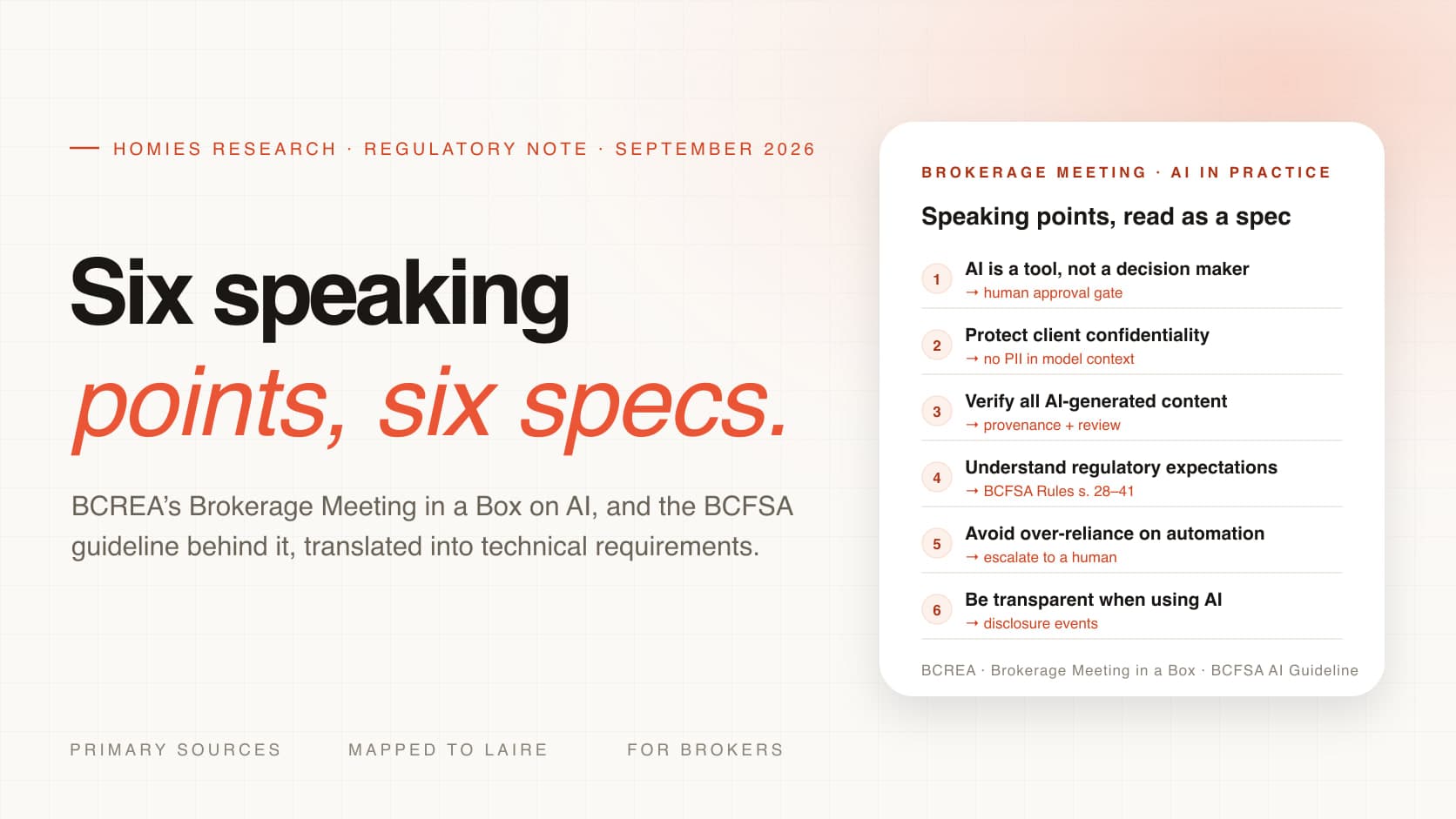
What BCREA did
Packaged six speaking points on responsible AI for managing brokers, with links to BCFSA’s rules and an offer to present in person.
What BCFSA requires
Full licensee accountability, client consent and confidentiality, verified and labelled output, bias awareness, and managing-broker supervision.
What it means technically
Approval gates, no PII in model context, provenance, encoded rules, human escalation, and disclosure events, the controls LAIRE specifies.
Planning and legal notice
This note analyses BCREA’s member resource and BCFSA’s published guideline and information pages as of September 3, 2026. It is not legal advice. BCREA’s resource is a speaking-point package rather than a rule, BCFSA guidelines are the regulator’s interpretation rather than statute, and brokerage policies vary. Confirm current obligations with BCFSA, your managing broker, and counsel before relying on any reading here.
The resource
Guidance written for the room where policy actually gets set
Most AI guidance in real estate is written for individual agents. The British Columbia Real Estate Association wrote its edition of Brokerage Meeting in a Box for the person who decides what tools a brokerage allows: the managing broker. The format is a set of speaking points and linked resources for a brokerage meeting, and BCREA offers to send one of its Professional Services Support Advisors, Jim McCaughan or Marty Douglas, to present the material online or in person.
The choice of audience is the point. In British Columbia, the managing broker is the licensee the regulator holds responsible for supervision under section 28 of the Real Estate Services Rules. A speaking-point package aimed at that role turns AI from an individual habit into a brokerage policy decision, which is exactly where BCFSA’s own guideline says it belongs. The key takeaway BCREA gives brokers to close the meeting is that AI can improve efficiency and support the work, but the REALTOR® remains responsible for accuracy, confidentiality, transparency, and professional judgement in every client interaction.
6
Speaking points in BCREA’s AI edition, each pointing at an existing duty rather than a new rule.
ss. 28–41
Real Estate Services Rules BCFSA cites in its AI Guideline: managing-broker responsibilities, duties to clients, honesty, reasonable care, and advertising.
Feb 2024
BCFSA published its Artificial Intelligence Guideline, still the most detailed regulator-level AI guidance for real estate licensees in Canada.
0
AI-specific statutes in force in Canada or BC, per BCFSA. Existing privacy, human rights, tort, and RESA obligations apply in full.
The speaking points
Six things BCREA wants every licensee to hear
The points are short enough to read aloud. We reproduce their substance here because the rest of this note argues that each one is a technical requirement in plain clothes.
1. AI is a tool, not a decision maker
AI can support drafting, summarizing, and analysis, but it does not replace professional judgement. REALTORS® remain responsible for all advice, communications, and decisions made with clients.
2. Protect client confidentiality
AI tools may store or process information externally. Avoid entering client names, financial or transaction details, and confidential brokerage information. Treat AI tools as potentially public environments unless confirmed otherwise.
3. Verify all AI-generated content
AI output can be inaccurate, outdated, and misleading. Review outputs carefully, validate facts before use, and apply human judgement before sharing with clients.
4. Understand regulatory expectations
AI use must align with BCFSA’s rules and obligations and with brokerage policies and procedures. Using AI does not reduce professional responsibilities; REALTORS® remain fully accountable for the accuracy of what they provide.
5. Avoid over-reliance on automation
Over-reliance introduces risks: missed context in complex or emotional situations and poor client experiences when human judgement is removed. AI should augment, not replace, client-facing interactions.
6. Be transparent when using AI
Clients should clearly understand when AI is being used to influence information, communications, or decisions, for example AI-generated listing descriptions, market summaries, and client communications. AI use must not mislead or create false impressions.
Two things stand out. First, the list is almost identical in substance to CREA’s national principles (transparency, accuracy, accountability) and to the California DRE’s bulletin (AI as an assistant under supervision, verification, disclosure, confidentiality). Three bodies in three jurisdictions, none of them coordinating, arrived at the same six ideas. Second, the second point is the most operational sentence any Canadian association has published on AI: treat AI tools as potentially public environments unless confirmed otherwise. That is a data-classification rule, and it has a direct architectural answer.
The regulator
BCFSA’s guideline is where the speaking points get their teeth
BCREA’s fourth point says AI use must align with the BC Financial Services Authority’s rules. The document it means is BCFSA’s Artificial Intelligence Guideline , published in February 2024 alongside an information page on what AI is and how licensee duties apply to it. Its opening position is the one every regulator has since echoed: using AI does not exempt a licensee from legal and ethical obligations, and licensees remain fully accountable for their actions.
What makes the BCFSA guideline unusual is its specificity. It cites the exact Rules that AI use engages and works through four areas of concern with examples drawn from practice.
| Area of concern | Rules engaged | What BCFSA expects |
|---|---|---|
| Exercise caution with generative AI | Rules 30 (duties to clients), 33 (honesty), 34 (reasonable care and skill) | AI lacks licensure and offers no dependable warranties; it guesses when information is incomplete. Do not rely on output without thorough review. Do not use AI to advise outside your expertise or licence. Advise clients to seek independent professional advice where the Rules require it. |
| Advertising and altered media | Rules 40 (advertising restrictions), 41 (false or misleading advertising prohibited) | Virtual staging and enhancement may be acceptable, but altered photos and videos should be labelled so buyers are not misled. Licensees may not publish advertising they know or ought to know is false or misleading, in text or in pictures. |
| Protect client information | RESA confidentiality duties; Personal Information Protection Act s. 14 | Never assume inputs are private; anonymized data can be re-identified. Obtain informed consent before using client information in an AI tool, review the provider’s privacy disclosures, and avoid entering confidential or personal information unless certain the tool does not store or use it. |
| Ensure accuracy | Rules 34, 40, 41 | Verify results before use. Licensees remain accountable for the accuracy of advertising and representations. Tell clients and the public when AI tools are used and explain their impact and limitations, for example an AI chatbot answering when the licensee is unavailable. |
| Understand systemic bias | Human rights law; Rule 30 | Training data can reproduce societal prejudice; tenant screening may rank people differently by race, gender, or language. Verify AI-generated data, establish procedures for error and bias correction, and tell tenant applicants and other affected parties when AI is used. |
The guideline also raises a data-use concern that most AI policies miss. It notes that vendors offering AI services such as strata-document review could reuse the incidental data those documents contain for insurance, marketing, or competitive analysis, and it asks licensees to consider that before adopting a tool. In LAIRE terms, that is a retention and secondary-use question, and it belongs in the vendor contract, not in a privacy policy nobody reads.
Supervision
BCFSA assigns the managing broker five jobs
BCREA aimed its resource at managing brokers because BCFSA did first. The guideline’s managing-broker section reads like a brokerage AI policy outline, and it is the reason a brokerage meeting, not an agent newsletter, is the right venue.
- Brokerage policies: establish clear policies and procedures for AI tools and client information, including protocols for data retention, encryption, and secure sharing, and emphasize anonymizing personally identifiable information before anything enters an AI system.
- Risk mitigation: treat AI output as a supplement to licensee expertise, not a replacement; require referrals for independent professional advice outside a licensee’s expertise; and discuss AI use with the brokerage’s insurer to confirm coverage.
- Educate licensees: make sure every licensee understands the risks, the importance of protecting client information, data privacy regulation, confidentiality, and the proper use of AI tools.
- Vendor due diligence: vet third-party AI tools so their data handling aligns with brokerage privacy policies, client agreements, and obligations under RESA; review terms of service and privacy agreements.
- Ongoing supervision: continuously monitor how licensees use AI tools and regularly review AI-generated content for policy alignment and accuracy.
The last item is the hardest and the most important. Continuous monitoring of how licensees use AI, and regular review of what it produced, is impossible if the tools leave no record. A managing broker cannot supervise a consumer chatbot session that happened on an agent’s phone. Supervision at the standard BCFSA describes requires the tools themselves to report what they did, for whom, on which data, and with what approval. That is not a policy feature. It is a product feature.
For engineers
Each speaking point is a requirement on the software
A licensee cannot personally deliver most of what BCREA and BCFSA ask if the software does not make it possible. Here is the translation from speaking point to system property, which is how we read every regulator’s guidance before it becomes a control.
| BCREA speaking point | What it means technically | Failure it prevents |
|---|---|---|
| 1. A tool, not a decision maker | Consequential outputs (advice, offers, screening, pricing) route to a licensed human for approval before they reach a client; the AI proposes and the licensee decides, with the decision recorded. | An AI quietly making a representation, a recommendation, or a tenant decision that a licensee never saw. |
| 2. Protect client confidentiality | Client identity, finances, and transaction details stay in the brokerage’s systems of record; the model receives opaque references and the minimum fields for a declared purpose; nothing is retained for training, memory, or retrieval. | Client data in a consumer chat history, a vendor’s training set, or a re-identifiable anonymized prompt. |
| 3. Verify all AI-generated content | Every factual claim carries a source in a system of record and a data-as-of time; deterministic services calculate prices, distances, and dates; unsourced claims are flagged before a human reviews the draft. | Fluent listing copy with an invented feature, a stale comparable, or a wrong measurement, published under Rule 41. |
| 4. Understand regulatory expectations | BCFSA’s Rules and BC’s privacy act are encoded as a jurisdiction profile the system applies to every action, and the system fails closed when it cannot determine which rules apply. | A national tool applying Ontario or California assumptions to a BC transaction. |
| 5. Avoid over-reliance on automation | Client-facing agents detect complexity, emotion, ambiguity, and opt-out, and hand off to a human with context; automation has ceilings per task and per day. | A grieving seller or a confused first-time buyer looping with a bot that cannot recognize it is out of its depth. |
| 6. Be transparent when using AI | The system records when AI materially influenced an output, what kind of influence, and whether and how the client was told; chatbots identify themselves; altered media is labelled with the original retained. | A client discovering after the fact that the market summary, the description, or the reply they relied on was machine-generated. |
There is a reinforcing trend from outside the province. The frontier model providers now enforce most of these requirements themselves. Anthropic’s usage policy classifies housing eligibility and legal interpretation as high-risk uses that require review by a qualified professional and disclosure to the consumer, and prohibits presenting AI output as human. OpenAI’s October 2025 update prohibits tailored legal advice without a licensed professional and automated high-stakes housing decisions without human review. Their browser agents refuse to bypass CAPTCHAs or handle credentials and hold the user responsible for sites’ automated-access terms. A brokerage tool that ignores BCREA’s speaking points is now also fighting its own model provider, and it loses that fight one refused task at a time. Compliance has become the interface through which capable AI agrees to work.
The framework
How LAIRE maps to BCREA and BCFSA
Our LAIRE framework (Layering Agentic Intelligence on Real Estate, formerly RAILS) is built on capability without custody: the AI may be granted narrow, identity-bound, auditable capabilities while client, listing, and transaction data stay in the systems that own them. Version 2.0, published today, adds a regulatory-alignment section and a British Columbia jurisdiction profile skeleton. The mapping to BCREA’s six points is one-to-one.
| BCREA / BCFSA expectation | Rule anchor | LAIRE control |
|---|---|---|
| A tool, not a decision maker; licensees remain accountable | Rules 30, 33, 34; BCFSA guideline purpose statement | Capability tiers with licensed-human review at Tier 4 and step-up, exact-version approval at Tier 5; the human principal named in every delegation receipt; responsibility allocation in the accountability profile. |
| Protect confidentiality; consent before client data enters a tool; anonymize | RESA confidentiality; PIPA s. 14; BCFSA managing-broker policies | Protected client-data domain with the CRM as system of record; purpose-bound minimum fields and opaque references; consent reference in the delegation; nine retention surfaces enumerated with training prohibited. |
| Verify output; accurate advertising; label altered media | Rules 34, 40, 41 | Provenance envelope on every output; deterministic calculation; exact-artifact review; the media provenance capability with alteration class, original reference, and rendered label. |
| Align with BCFSA rules and brokerage policy | Rule 28; BCFSA guideline | A signed ca-bc jurisdiction profile binding capabilities to counsel-reviewed BC rules; model policy clauses for brokerage adoption; fail-closed behaviour when jurisdiction is undetermined. |
| Avoid over-reliance; augment, do not replace, client interaction | Rules 30, 34 | Hard handoff to a human on complexity, emotion, ambiguity, or opt-out in the conversation capabilities; per-task and daily ceilings; reach-a-human path in the accountability profile. |
| Transparency; tell clients and affected parties when AI is used | BCFSA accuracy and bias sections; Rules 40, 41 | Meaningful-disclosure requirement, self-identifying agent communications, and disclosure recorded as an evidence event. |
| Managing-broker supervision, vendor diligence, and monitoring | Rule 28; BCFSA managing-broker considerations | Canonical evidence events exportable to the brokerage as the accountable organization; capability-level certification with contractual representations on training, retention, subprocessors, incidents, and insurance. |
| Systemic bias in screening and recommendations | Human rights law; BCFSA bias section | Anti-steering by design, prohibited-feature and proxy catalogues, objective-criteria logging, and disparate-impact testing in the conformance kit. |
For brokers and builders
What to do with this now
If you are a managing broker in BC: run the meeting. Then write the policy BCFSA describes: approved tools, prohibited inputs, consent language for client data, labelling rules for altered media, review before release, a vendor due-diligence checklist, and a supervision routine. Ask every vendor one question before anything else: can you show me, per licensee, what your tool did, on which data, and who approved it? If the answer is no, you cannot meet BCFSA’s ongoing-supervision expectation with that tool, whatever its other merits.
If you are a licensee: treat BCREA’s second point as a hard rule until your brokerage confirms a tool otherwise. Nothing that identifies a client goes into a tool your brokerage has not approved. Label staged and enhanced media. Tell clients when a chatbot answered for you. Verify every fact in AI-drafted copy against the listing record before it is published under your name and Rule 41.
If you build technology: build to the BCFSA standard everywhere, because it is the most specific in Canada and it matches CREA’s principles and the California DRE’s bulletin almost line for line. Implement approval gates, minimization, provenance, jurisdiction profiles, human escalation, disclosure events, and supervision exports as product features. That is how we built Homies, and it is why a brokerage meeting like BCREA’s reads to us as a product walkthrough rather than a warning. We hope the rest of the industry builds the same way.
Questions
Frequently asked questions
What is BCREA’s Brokerage Meeting in a Box on artificial intelligence?
It is a managing-broker resource from the British Columbia Real Estate Association that packages speaking points and links for a brokerage meeting on responsible AI use. The AI edition has six points: AI is a tool, not a decision maker; protect client confidentiality; verify all AI-generated content; understand regulatory expectations, including BCFSA rules; avoid over-reliance on automation; and be transparent when using AI. BCREA also offers to send a Professional Services Support Advisor to present it in person or online.
What does BCFSA say about real estate licensees using AI?
The BC Financial Services Authority’s Artificial Intelligence Guideline, published in February 2024, says using AI does not exempt a licensee from legal and ethical obligations and that licensees remain fully accountable. It flags four areas: exercise caution with generative AI, protect client information and obtain consent, ensure the accuracy of AI output and label altered advertising media, and understand systemic bias. It cites Real Estate Services Rules sections 28, 30, 33, 34, 40, and 41 and sets out managing-broker duties for policy, risk mitigation, education, vendor due diligence, and ongoing supervision.
Can a BC REALTOR® enter client information into ChatGPT or a similar tool?
BCFSA’s guideline says licensees should avoid entering confidential or personal information into an AI tool unless they are certain the tool does not store or use user data, and should obtain the client’s informed consent before using client information in an AI tool. BCREA’s speaking points say to avoid entering client names, financial or transaction details, and confidential brokerage information, and to treat AI tools as potentially public environments unless confirmed otherwise.
Do BC licensees have to disclose when they use AI with clients?
BCFSA advises licensees to communicate to clients and the public when AI tools are used and to explain their impact and limitations, for example when an AI chatbot answers while the licensee is unavailable, and to label photos or videos that have been altered or virtually staged. BCREA’s sixth speaking point says clients should clearly understand when AI is being used to influence information, communications, or decisions.
Is there an AI law in British Columbia?
No. BCFSA notes that no statute specifically regulates the development or use of AI in Canada or BC, and that AI use is governed by privacy legislation (including BC’s Personal Information Protection Act), human rights legislation, tort law, and the Real Estate Services Act framework. That is why the regulator’s guideline anchors AI obligations to existing Rules rather than to a new statute.
What do BCREA’s six points require of AI software?
Each point implies a system property: a human approval gate before consequential decisions; no personally identifiable client data in model context; provenance and verification on every output; jurisdiction-aware rules that encode BCFSA expectations; escalation paths to a human for complex or emotional situations; and disclosure events that record when and how a client was told AI was involved. The LAIRE framework specifies those as certifiable controls.
What is the LAIRE framework?
LAIRE, Layering Agentic Intelligence on Real Estate (formerly RAILS), is Homies Research’s governance and technical framework for agentic AI in real estate, built on capability without custody. Version 2.0 adds a regulatory-alignment section that maps BCREA’s speaking points and BCFSA’s guideline, along with CREA, C.A.R., the DRE, NAR, and state AI law, onto named controls and a British Columbia jurisdiction profile.