C.A.R.’s AI Resource Hub: California’s AI Rules for Realtors, Decoded
The California Association of REALTORS® put the state’s AI rules on one page. Read as a technologist, that page is a specification for how real estate AI has to be built.
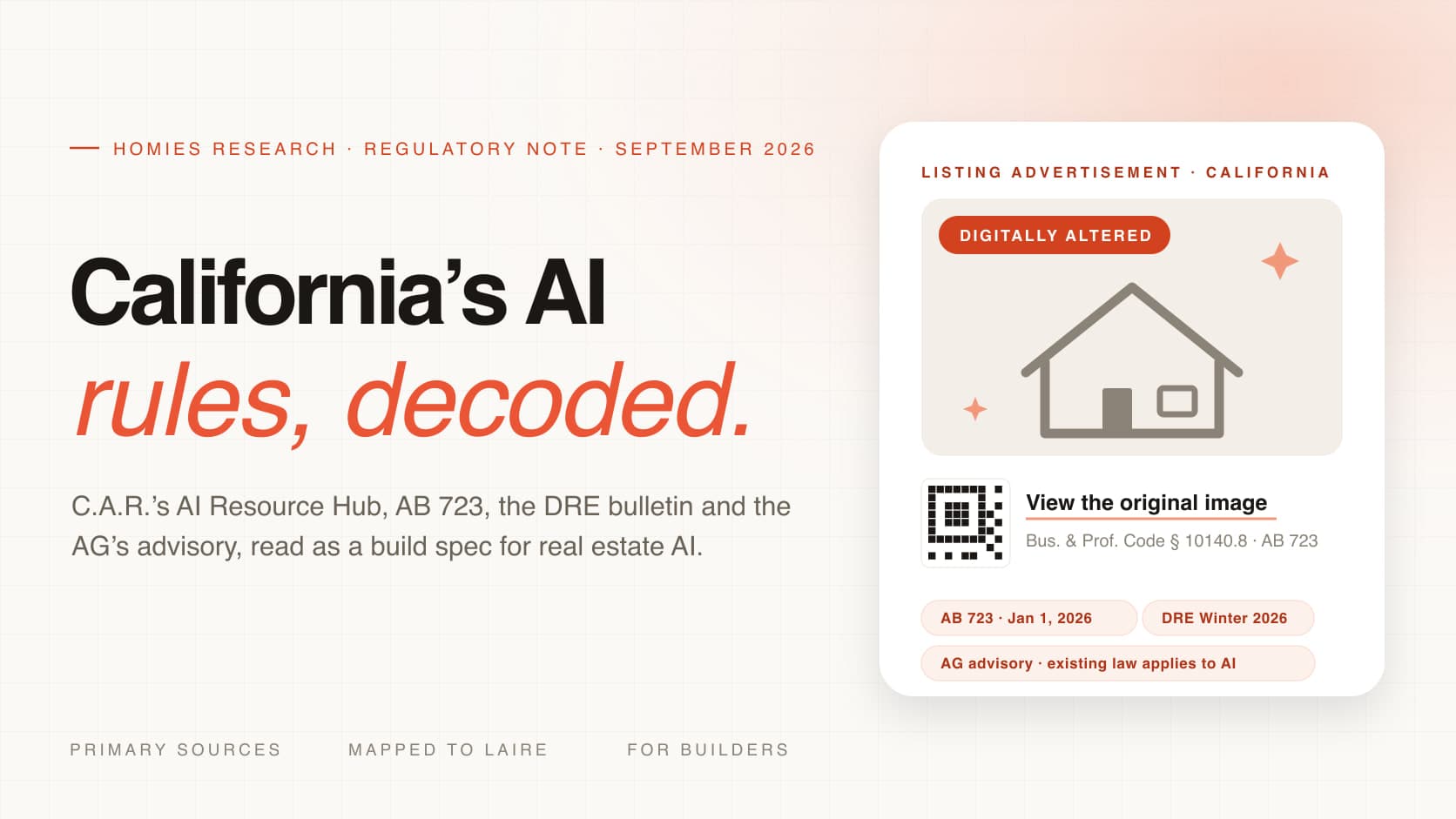
What C.A.R. did
Collected its legal Q&A, the AB 723 explainer, the AG advisory, the DRE bulletin, and NAR’s AI resources into one member hub.
What it requires
Disclosed and reversible image edits, verified outputs, licensed review, broker supervision, and careful client-data handling.
What it means for builders
Compliance is no longer a policy layer on top of the AI. It has to be implemented in the harness itself, which is what LAIRE specifies.
Planning and legal notice
This note is analysis of publicly available association, regulator, and government material as of September 3, 2026. It is not legal advice. Some C.A.R. resources are member-only; where we could not read a document directly, we describe it as C.A.R. describes it. Verify current law, DRE regulations, MLS rules, and brokerage policy with counsel before relying on any of it.
The hub
C.A.R. did not write new rules. It assembled the ones that already bind you.
The C.A.R. AI Resource Hub is modest in format and significant in effect. It is a curated page, not a policy statement, but by placing the state Attorney General’s advisory, the Department of Real Estate’s bulletin, the new altered-images statute, and NAR’s policy templates next to its own legal guidance, the largest state REALTOR® association in the United States has told roughly 200,000 members which documents govern their use of AI. That curation is itself a compliance signal: a broker who is later asked why an AI tool produced a misleading listing cannot claim the rules were scattered or unclear.
The hub has four layers:
- C.A.R. Legal: the AI Compliance in a Nutshell Q&A, an article on AB 723 (the digitally altered images law effective January 1, 2026), and a test in which C.A.R. Legal compared ChatGPT’s answers to three common Legal Hotline questions against attorney answers.
- The State: the California Attorney General’s Legal Advisory on the Application of Existing California Laws to Artificial Intelligence, covering consumer protection, civil rights, competition, and privacy law.
- The regulator: the DRE’s Winter 2026 Real Estate Bulletin article, Artificial Intelligence in California Real Estate, which identifies common AI uses and the compliance steps licensees must take.
- NAR: the Deepfakes and the Growing AI Fraud Threat webinar (recorded July 29, 2026), the article What’s Real, What Isn’t?, the Why Every Brokerage Needs an AI Use Policy explainer, and AI policy templates for brokers and for associations.
Jan 1, 2026
AB 723 took effect, adding section 10140.8 to the Business and Professions Code.
456%
Surge in AI-enabled fraud attempts between May 2024 and April 2025, per Chainabuse data cited by NAR.
Aug 2, 2026
The California AI Transparency Act became operative, requiring latent provenance marks and free detection tools from large generative AI providers.
Jan 1, 2027
CCPA automated decision-making rules apply, with housing named as a significant decision.
The pattern across all four layers is the same one we see from CREA, BCREA, and BCFSA in Canada: no regulator is creating an AI exemption, and none is banning AI. They are restating existing duties, accuracy, disclosure, supervision, confidentiality, and fair housing, and telling licensees those duties travel with them into every tool they use. For technology companies, that restatement is the important part. A duty that follows the licensee into the tool is a duty the tool has to help discharge.
The statute
AB 723: every altered listing image now needs a label and an original
AB 723, signed in October 2025 and in force since January 1, 2026, added section 10140.8 to the Business and Professions Code. It is the first California statute written specifically for AI-touched real estate advertising, and it is precise in a way that makes it easy to implement and hard to talk around.
What counts as altered
An image changed with editing software or AI to add, remove, or change elements: fixtures, furniture, landscaping, views, neighbouring properties. Lighting, sharpening, white balance, colour, angle, straightening, cropping, and exposure adjustments that do not misrepresent the property are excluded.
The disclosure
A reasonably conspicuous statement that the image has been digitally altered, placed on or adjacent to the image itself, not buried in remarks.
The original
A link, URL, or QR code to a publicly accessible page that includes and clearly identifies the original, unaltered image.
Who is covered
Brokers, salespersons, and anyone acting on their behalf, in advertisements or promotional material for the sale of real property. Violations fall under the existing Real Estate Law’s disciplinary framework.
Notice what the statute does not do. It does not ban virtual staging, AI decluttering, or renovation renderings. It regulates provenance. The original must exist, must be reachable, and must be identified as the original. That is the same design pattern CREA chose for the DDF a few months later (original-first display, labelled opt-in overlays, nothing that replaces the record), and it is the pattern MLSs such as CRMLS have written into photo rules. Two regulators on opposite sides of the continent converged on one architecture: the augmentation is a view, the original is the record.
For an AI system, that has three consequences. Every generated or edited asset needs a durable link to its source asset. The alteration has to be classified at creation time, because the disclosure decision depends on whether elements were added, removed, or changed versus merely corrected. And the original has to be published somewhere the licensee controls, which means the media pipeline, not the model, owns the artifact. A tool that returns a staged JPEG with no lineage cannot be used compliantly in California without a human rebuilding the lineage by hand.
The regulator
The DRE bulletin: AI is an unlicensed assistant, and the broker supervises it
The most consequential document on the hub is the least glamorous. In its Winter 2026 Real Estate Bulletin , the Department of Real Estate published a five-page article, Artificial Intelligence in California Real Estate: Opportunities, Risks, and Compliance Considerations for Licensees. It reads like a preview of enforcement priorities.
The DRE starts by naming the six ways licensees actually use AI: marketing and advertising, including AI-enhanced imagery; chatbots and lead scoring; automated valuation and dynamic pricing; transaction and document review; property management, including tenant screening; and mortgage servicing analytics. It then applies three unchanged principles. Only DRE licensees may perform licensed activity. Brokers must reasonably supervise activity under their licence (sections 10177(h) and 10159.2 and Regulation 2725). Licensees owe fiduciary duties. From those it draws the line that will be quoted in disciplinary decisions for years: using AI to conduct licensed activity may be equivalent to asking an unlicensed assistant to do licensed activity, which is a violation of California real estate law. Responsibility for inaccurate output, in the DRE’s words, rests with the licensee and their responsible broker, not the technology provider.
| DRE expectation | Legal anchor | What the system has to do |
|---|---|---|
| Broker supervision extends to AI tools | B&P §§ 10177(h), 10159.2; Reg. 2725 | Give the broker an inventory of tools, actions, and outputs per licensee. Supervision needs telemetry: who ran what, on which data, with what result. |
| AI may not perform licensed activity unsupervised | B&P § 10131; the DRE’s unlicensed assistant guide | Route anything that looks like advice, negotiation, or a representation to a licensed reviewer before it reaches a consumer. The AI proposes; the licensee approves. |
| Advertising must be truthful whoever wrote it | B&P § 10176; § 10140.6 first-contact identification | Verify factual claims against the system of record before publication and stamp licensee name, licence ID, and broker identity on first-contact material automatically. |
| Altered images need disclosure and originals | B&P § 10140.8 (AB 723) | Classify edits at creation, attach the original, render the disclosure on or adjacent to the image, and keep the original reachable. |
| Fair housing has no AI exemption | FEHA, Gov. Code §§ 12955–12956.1; Holden Act; Reg. 2780 | Reject protected-class criteria and proxies in targeting, screening, and pricing; log the objective criteria behind every ranking so disparate impact can be tested. |
| Client data must be handled lawfully | CCPA, Civ. Code §§ 1798.100–1798.199 | Know what each tool collects, retains, and shares; keep confidential client information out of public or unsecured platforms; minimize by default. |
| No unauthorized practice of law | B&P §§ 6125–6126 | Contract language and legal interpretation stay inside approved forms and counsel channels; the AI can summarize and flag, not advise. |
The bulletin closes with five best practices: understand the tool’s limits, maintain human oversight, implement written policies and training, document compliance steps, and stay informed. Documentation gets a specific rationale: records showing how AI outputs were reviewed may help demonstrate good-faith compliance if questions arise. That is the regulator telling licensees that an audit trail is a defence. A harness that does not produce one leaves the licensee without it.
The State
The Attorney General: AI involvement is not a defence, and vendors are on the hook too
The Attorney General’s legal advisory , issued in January 2025, is not about real estate. It is about everything, which is why it matters here. Its thesis is that California did not need a new AI statute for most harms because the Unfair Competition Law, the False Advertising Law, the Unruh Civil Rights Act, the Fair Employment and Housing Act, the CCPA, and the Invasion of Privacy Act already reach them. Conduct that is illegal without AI is equally illegal with it, and the advisory says plainly that AI involvement is not a defence to liability under any law.
Three passages should be read by every proptech founder and every broker who buys from one:
- Deception by design: it is likely unlawful to represent that a system is fully AI-powered when humans do part of the work, or that humans are responsible when AI is, and in many contexts it is deceptive to fail to disclose that AI created a piece of media. Undisclosed AI listing copy, voices, and images sit squarely inside that sentence.
- Aiding and abetting: businesses may be liable for supplying AI products when they know, or should have known, that the AI will be used to violate the law. A vendor that ships a tool that can only work by scraping an MLS or impersonating an agent is not a bystander.
- Housing and privacy: FEHA is named explicitly, agents carrying out discriminatory screening can be directly liable, and the CCPA treats inferences an AI makes about a consumer as personal information, with AB 1008 confirming the law reaches personal information inside AI systems.
The advisory also catalogues the state’s newer AI statutes: training-data transparency (AB 2013), the AI Transparency Act (SB 942, now operative since August 2, 2026 after AB 853 moved the date), AI disclosure in telemarketing (AB 2905), and the bot-disclosure rule that forbids undeclared chatbots from nudging a purchase (Business and Professions Code section 17941). Add the CCPA regulations on automated decision-making technology, finalized in September 2025 and applying from January 1, 2027 with housing listed as a significant decision, and California now has a layered regime: general law applies to AI, specific statutes govern provenance and disclosure, and privacy rules govern automated decisions about people.
The national layer
NAR: policy templates, fraud warnings, and a chief data officer’s caution
The NAR material C.A.R. links completes the picture from the top of organized real estate. NAR’s AI hub advocates a uniform federal framework, copyright protection for listings and MLS data, and fair housing and privacy safeguards, and it points members to Article 2 of the Code of Ethics, which prohibits exaggerating, concealing, or misrepresenting pertinent facts, as the rule that already governs AI-enhanced content. The deepfake guidance (August 3, 2026) is practical: never wire on an email, text, or voicemail alone; verify through a trusted number; expect cloned voices and faked video closings.
The most useful NAR contribution for builders is the June 2026 broker session in which NAR’s chief data officer, David Conroy, listed the agentic risks brokers face. AI can act on stale, incomplete, or non-compliant data because MLS rules are not machine readable. Automated messaging can create a discriminatory pattern nobody intended. Models hallucinate claims and drop required disclaimers. And things get, in his words, dicey when an AI tool acts in ways that resemble licensed activity. His advice was to adopt an accessible AI policy now, require human review before anything AI-generated is released, and refine over time. NAR’s AI Policy Template for Brokers (member login) and template for associations exist to make that fast.
MLSs are moving on the data side of the same problem. Milwaukee’s Metro MLS now prohibits using MLS data for AI training without written consent and defines training broadly enough to include embeddings and synthetic datasets. FBS shipped a Flexmls MCP server gated on subscriber credentials in April 2026, and Cotality followed with an OAuth-authenticated, query-logged MCP server. WAV Group’s August 2026 analysis argues that the bigger leak is agents pointing browser-based AI at authenticated MLS sessions with no logging at all, and recommends rules of use that cover automated extraction through those sessions. That is the exact browser-as-shadow-API problem LAIRE was written to close.
The patchwork
California is first, not alone
C.A.R.’s hub is a California document, but the direction it describes is national. Between late 2025 and mid-2026, a state-by-state patchwork formed around the same two questions: when must AI-altered listing media be disclosed, and when must a human stand behind an automated decision about a person?
| Jurisdiction | Rule | Status |
|---|---|---|
| Wisconsin | 2025 Act 69 requires disclosure when listing advertising for one-to-four-unit residential property is altered with technology, including AI, in a way that could mislead, with a good-faith safe harbour. | Enacted December 9, 2025; effective January 1, 2027. |
| New York | The Department of State issued a trend alert on AI-generated listing images; misleading advertising is disciplinable under Real Property Law § 441-c and 19 NYCRR § 175.25. | Alert issued November 13, 2025; existing rules apply now. |
| Colorado | SB 26-189 repealed and re-enacted the 2024 AI Act as a narrower automated decision-making technology law; housing remains a covered consequential decision, with consumer notice and adverse-outcome disclosure duties. | Signed May 14, 2026; effective January 1, 2027. |
| Texas | The Texas Responsible AI Governance Act sets general AI conduct rules; TREC advertising rules continue to prohibit deceptive listing media without a photo-specific mandate. | TRAIGA effective January 1, 2026. |
| California (privacy) | CCPA regulations on automated decision-making technology, risk assessments, and cybersecurity audits; housing is a significant decision. | Effective January 1, 2026; ADMT duties from January 1, 2027. |
| MLS rules | CRMLS, SDMLS, Stellar MLS, Bright MLS, NorthstarMLS, and NTREIS have adopted labelling and original-availability rules for staged or AI-edited photos; Metro MLS prohibits AI training on its data. | In force through 2026 rule cycles. |
The federal picture is unsettled. NAR is lobbying for a single national framework and the White House has signalled a preference for federal legislation over state laws, but as of September 2026 nothing has pre-empted the patchwork. A system built for California’s rules today is, in practice, built for the strictest common denominator, which is the only sane engineering target when the map changes quarterly.
For engineers
What actually changes when you build for this
Most commentary on these documents stops at advice for agents: verify, disclose, supervise. We want to go one level down, because every one of those verbs implies a system property. Here is the specification hiding inside the hub.
Provenance is a data model, not a caption
Every asset and every claim an AI produces needs a source reference, a data-as-of time, an alteration class, and a link to the original. AB 723 makes this literal for images; the DRE makes it practical for everything else.
Human review has to be structural
A licensed reviewer must be able to see the exact artifact, approve that exact version, and have the approval invalidated if the artifact changes. A checkbox that says reviewed is not what the DRE described.
Supervision needs telemetry
Brokers cannot reasonably supervise what they cannot see. The harness has to emit per-action events: actor, tool, data class, output, approval, outcome. That is also the good-faith record the DRE says may help in an inquiry.
Fair housing is a control surface
Targeting, ranking, screening, and pricing capabilities need prohibited-feature and proxy catalogues, objective-criteria logging, and disparate-impact testing before and after launch.
Disclosure is an event
When AI materially shapes a communication, a listing, or a recommendation, the system should record that it disclosed it, to whom, and how. The AI Transparency Act’s latent marks give media a machine-readable version of the same idea.
Data minimization is a default, not a setting
Client identity, finances, and transaction details stay in the system of record; the model receives references and the minimum fields for a declared purpose. The DRE and the AG both point at this; the CCPA enforces it.
There is a second, quieter shift. The frontier model providers have moved in the same direction as the regulators. Anthropic’s usage policy, effective September 15, 2025, classifies decisions about housing eligibility, leases, and home loans as high-risk uses that require review by a qualified professional and disclosure to the consumer that AI is involved. OpenAI’s October 2025 policy update prohibits tailored legal advice without a licensed professional and automating high-stakes decisions, including housing, without human review. Anthropic’s browser agent will not bypass CAPTCHAs, enter sensitive data, or execute financial transactions, and it makes the user responsible for third-party terms that restrict automated access. In practice, this means an AI workflow that depends on scraping a portal, borrowing an agent’s MLS login, or auto-deciding on a tenant increasingly does not run, because the model declines, the harness blocks it, or the platform’s terms forbid it.
That is why we describe compliance as the interface. The tools that will do the most work in real estate are the ones that can execute inside the rules, because those are the only ones the models and harnesses will keep executing. We designed Homies that way from the start, and we would rather compete with other companies that did the same than watch the industry learn this from enforcement actions.
The framework
How LAIRE maps to C.A.R.’s hub
Our LAIRE framework (Layering Agentic Intelligence on Real Estate, formerly RAILS) was written around one boundary: the AI may receive capabilities, it must not receive custody. Version 2.0, published today, adds a regulatory-alignment section that maps each regulator’s expectation to a named control. The California mapping looks like this.
| Expectation | Source | LAIRE control |
|---|---|---|
| Altered media carries disclosure and an original | AB 723; DRE bulletin | Media provenance envelope with alteration class, original reference, and rendered disclosure; originals published by the participant-controlled application. |
| A licensed human stands behind consequential output | DRE bulletin; AG advisory | Tier 4 and Tier 5 capabilities require exact-version approval bound to a document hash, with step-up authentication for binding actions. |
| Brokers can supervise AI activity | B&P §§ 10177(h), 10159.2; Reg. 2725 | Canonical evidence events per action, exportable to the brokerage, with tool, actor, data class, approval, and outcome. |
| No discriminatory targeting, screening, or steering | FEHA; Reg. 2780; AG advisory | Prohibited-feature and proxy catalogues, objective-criteria logging, disparate-impact testing in the conformance kit. |
| Client data stays protected and minimized | CCPA; DRE bulletin | Protected data domains with systems of record; opaque references and purpose-bound minimum fields in model context; nine retention surfaces enumerated. |
| Consumers know when AI is involved | AG advisory; B&P § 17941; AI Transparency Act | Disclosure events in the accountability profile; chatbots and agent communications identify themselves; latent marks preserved on media. |
| Vendors share responsibility | AG advisory (aiding and abetting) | Capability-level certification with contractual representations on training, retention, subprocessors, incident notice, and insurance. |
For members and builders
What to do with this now
If you are a California licensee: treat the hub as your reading list. Audit every listing photo published since January 1 for section 10140.8 compliance, because the DRE has said unintentional alterations still count. Ask each AI tool you use three questions: where does my client data go, can I see and approve the exact output before it leaves, and does it keep a record I could hand my broker. If the answer to any of them is no, the DRE bulletin says the exposure is yours.
If you run a brokerage: adopt a written AI policy this quarter using NAR’s template, name the approved tools, define what may never be entered into a public model, require human review before release, and document training. Then ask your vendors for the telemetry that makes supervision real: per-licensee tool activity, outputs, and approvals. Supervision that exists on paper but not in practice is the failure mode the DRE’s own bulletin calls out.
If you build technology: implement provenance, disclosure, approval, supervision telemetry, and minimization as first-class capabilities, not as a compliance page. Assume the AG’s aiding-and-abetting sentence applies to you. And read the model providers’ usage policies as product requirements, because their enforcement is automated and their refusals are already shaping which real estate workflows can run at all.
Questions
Frequently asked questions
What is C.A.R.’s AI Resource Hub?
It is a page on car.org where the California Association of REALTORS® collects its AI compliance material for members: a legal Q&A called AI Compliance in a Nutshell, a C.A.R. Legal article on AB 723 (the digitally altered images law effective January 1, 2026), a comparison of ChatGPT answers against C.A.R. Hotline attorney answers, the California Attorney General’s legal advisory on AI, the Department of Real Estate’s Winter 2026 bulletin article on AI, and NAR resources on deepfakes, brokerage AI policies, and association AI policies.
What does California AB 723 require for AI-edited listing photos?
Since January 1, 2026, Business and Professions Code section 10140.8 requires a real estate licensee who uses a digitally altered image in an advertisement for the sale of real property to include a reasonably conspicuous disclosure on or adjacent to the image, and to provide a link, URL, or QR code to a publicly accessible page that clearly identifies the original, unaltered image. A digitally altered image is one changed with editing software or AI to add, remove, or change elements such as fixtures, furniture, landscaping, views, or neighbouring properties. Routine adjustments to lighting, sharpness, white balance, colour, angle, straightening, cropping, or exposure are excluded.
What does the California DRE say about using AI in real estate?
The DRE’s Winter 2026 Real Estate Bulletin says AI does not change three principles: only licensees may perform licensed activity, brokers must reasonably supervise activity under their licence, and licensees owe fiduciary duties. Using AI to conduct licensed activity may be equivalent to asking an unlicensed assistant to do it. Responsibility for inaccurate AI output rests with the licensee and responsible broker, not the technology provider. The article also covers advertising accuracy, AB 723, fair housing, privacy, and unauthorized practice of law.
Does the California Attorney General’s AI advisory apply to real estate agents?
Yes. The advisory, issued in January 2025, explains that existing consumer protection, civil rights, competition, and privacy laws apply to anyone who develops, sells, or uses AI. It states that AI involvement is not a defence to liability under any law, cites FEHA’s housing protections and the CCPA, and warns that businesses can be liable for supplying AI products they know or should know will be used to break the law.
Do brokerages need a written AI policy?
The DRE bulletin recommends that brokers adopt written AI policies, train affiliated licensees, and document review and compliance practices. NAR has published customizable AI policy templates for brokers and for associations, and NAR’s chief data officer has urged brokers to adopt an accessible policy quickly and refine it over time.
How do these California rules change how real estate AI is built?
They turn disclosure, provenance, human review, supervision, and data handling into technical requirements. An AI system that produces listing media must carry alteration metadata and an original-image reference; AI communications must be disclosed; consequential outputs need a licensed reviewer before release; brokers need visibility into what tools did; and client data cannot flow into unsecured tools. The LAIRE framework specifies those controls as certifiable capabilities.
What is LAIRE and how does it relate to C.A.R.’s guidance?
LAIRE, Layering Agentic Intelligence on Real Estate (formerly RAILS), is Homies Research’s capability-without-custody framework for agentic AI in real estate. Version 2.0 maps regulator expectations, including the C.A.R. hub, AB 723, the DRE bulletin, and the Attorney General’s advisory, onto specific controls: disclosure events, provenance envelopes, exact-version human approval, delegated identity, and audit evidence.