Lovable for Realtors? Replit for Realtors? Where Is AI + IDX?
The obvious product should already exist: describe the Realtor website you want, watch an AI build it, and switch on approved MLS search. The website part is here. The listing-data boundary is why the combined product is not.
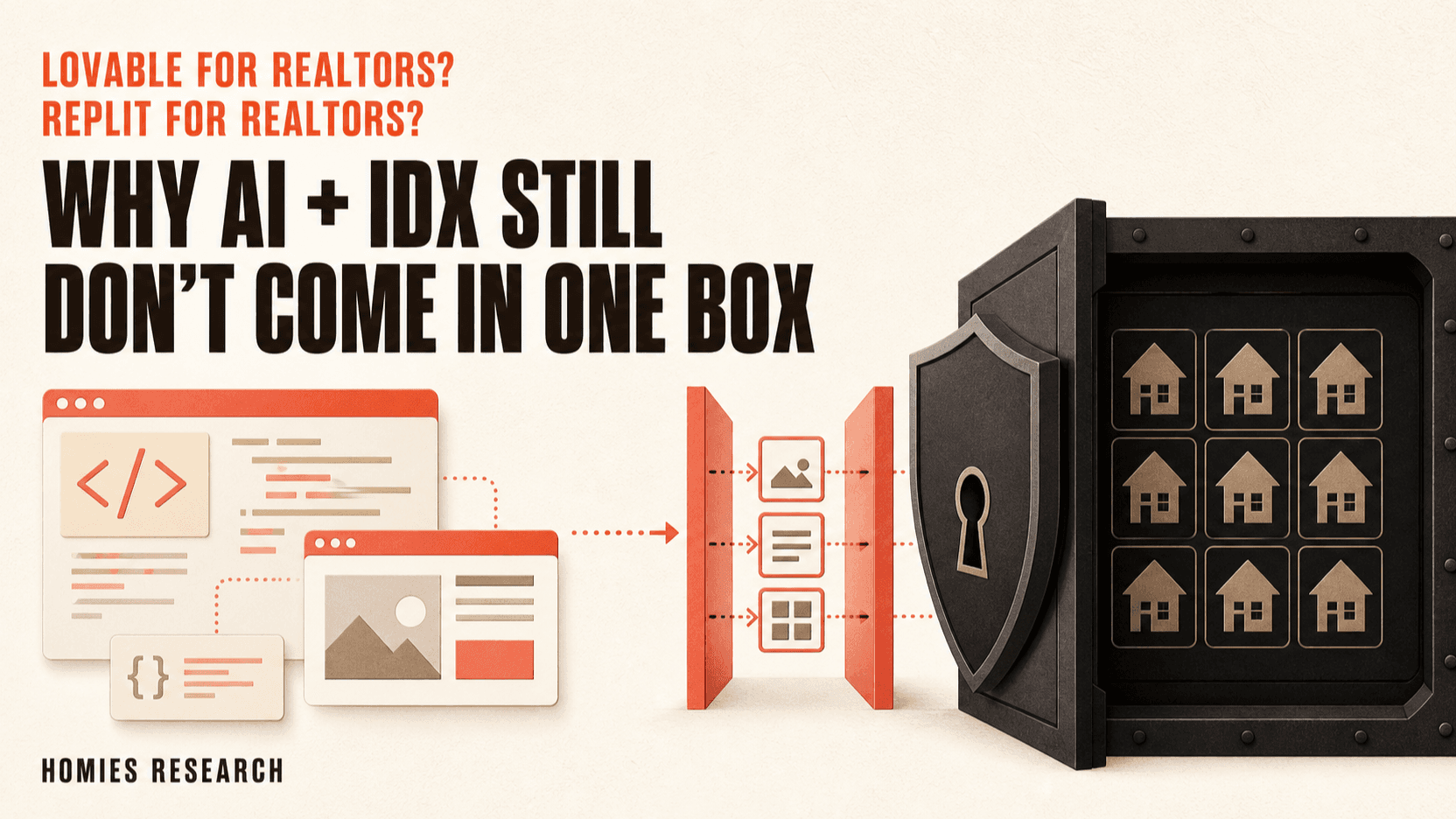
The market gap
AI site builders and IDX platforms still arrive as separate products
The hard part
Data rights, field rules, identity, security, provenance and audit
Our architecture
Homies creates the site; Valery IDX retains custody of live listing data
The direct answer
There should be a Lovable or Replit for Realtors. The missing product is not just a website builder.
If you searched for Lovable for Realtors, Replit for Realtors, an AI IDX website builder, or an AI real estate website builder with MLS search built in, the short answer is frustrating: the pieces exist, but there is still no obvious, widely available, one-click product that does the whole job across real estate boards and MLS markets.
General AI coding platforms can generate a polished website, database, forms, authentication, lead funnels and custom applications from natural language. Traditional IDX website companies can receive approved listing feeds and render compliant property search. Headless real estate APIs can provide developer endpoints. Some providers now expose listing search through Model Context Protocol, or MCP. Yet the Realtor still has to choose vendors, obtain data approval, connect credentials, build the experience, constrain what the AI can see, test display rules and maintain the integration.
The gap is not a lack of code generation. It is the absence of a product architecture that lets an AI coding agent change the website without giving that agent—or the model behind it—custody of the licensed listing database.
The product thesis
AI should be able to build the Realtor’s digital experience. It should not become the new home of the board’s data.
The products people mean
Lovable and Replit already proved that software can start with a conversation
Lovable describes itself as a full-stack AI development platform. A user explains the desired application in natural language, and Lovable can generate editable front-end code, a backend, database, authentication and integrations, then publish the result or sync the code into an engineering workflow. Read Lovable’s official platform overview and integration documentation .
Replit Agent follows the same broad product shift from coding syntax to stated intent. Replit says Agent can plan changes, write code, explain behaviour, debug issues and improve an app. Replit projects can also contain web applications and the backend, database and storage they need. See Replit’s Agent guide and project architecture .
Lovable for real estate
A compelling prompt-to-full-stack experience for pages, applications, auth, databases and integrations—but no built-in MLS participation right or universal IDX approval.
Replit for real estate
A flexible AI coding and deployment environment that can build a custom Realtor website—but the licensed data source, board approval and production boundary remain separate work.
Neither product is failing by not shipping a universal IDX switch. They are general-purpose builders. Real estate listing data is a specialized, licensed input whose permission can depend on the participant, brokerage, board, MLS, geography, destination, user class and intended use. A generic API key field is not the same as an authorized data-distribution system.
The real constraint
An IDX feed is not ordinary application data
When an AI builder creates a restaurant app, the owner can usually decide where the menu database lives and which tools may read it. A Realtor does not own the entire MLS or board database. The right to display or use listing information is derivative: it comes through a participant, brokerage, board, MLS, association, data provider or another agreement, and it is limited to specific purposes.
Those limits can govern which records and fields are available, whether sold or historical data may appear, who must sign in, how frequently data refreshes, what attribution and disclaimers must render, which destinations are approved, how much can be downloaded, how scraping is prevented, how access is audited and what happens when a licence ends.
NAR’s IDX policy centres participant-controlled display and says access to an MLS database may not be provided to an unauthorized person or entity. Its VOW policy adds consumer-registration, terms, security, supervision and anti-scraping controls for brokerage services delivered through a Virtual Office Website. The local rulebook and signed agreement still control the deployment. Review the current NAR IDX policy and NAR VOW policy .
- A coding agent needs enough context to change the product, but not the entire production feed.
- A website needs live results, but the query must execute under the participant’s actual entitlement.
- A model can propose a new search experience, but it cannot invent permission to expose a field or use.
- A deployment can be technically secure and still violate a board agreement if the destination or purpose is wrong.
SEO glossary · Real estate data feeds
IDX, VOW, CREA DDF, RESO Web API and RETS describe different parts of the system
“MLS integration” is often used as if it were one product. In practice, a Realtor website may combine a permission model, a display purpose, a data payload, a transport standard and a vendor runtime. These terms are related, but they are not interchangeable.
IDX — Internet Data Exchange
A policy and data-display path commonly used for public property search on participant-controlled websites and approved displays. The exact feed, fields and rules are set by the relevant MLS or board.
VOW — Virtual Office Website
A participant’s online brokerage-service environment for properly registered consumers. A VOW can make additional authorized MLS information available under identity, terms, supervision, security and audit requirements.
REALTOR.ca DDF® — Data Distribution Facility
CREA’s permission-based Canadian distribution service. Its Member Website Feed is one route for listing display on an approved member-controlled destination.
RESO Web API
The modern standards-based interface for real estate data, commonly using OData patterns and RESO Data Dictionary fields. RESO defines standards; it does not grant the underlying listing licence.
RETS — Real Estate Transaction Standard
The legacy real estate data transport still encountered in older MLS and vendor integrations. Newer systems increasingly use the RESO Web API, but production estates can contain both.
Board, MLS, brokerage and vendor feeds
Direct APIs, replicated databases, FTP or SFTP deliveries, broker back-office feeds, data shares and vendor-normalized APIs can all exist. The contract and approved use matter more than the acronym alone.
RESO explains that its Web API supports live application queries and standardized real estate payloads. CREA describes DDF as a permission-based distribution service. Those technical and distribution paths make an AI-generated website possible; they do not make every AI use permissible. See the RESO Web API overview and REALTOR.ca DDF overview .
The promising derivative
An IDX MCP server gives AI a tool. It does not give the Realtor a finished platform.
Model Context Protocol is becoming a useful way to expose real estate functions to an AI client. Repliers, for example, documents an MCP server that connects its API to assistants for listing search, property details, listing history and market analytics. Its own documentation also says the user remains responsible for complying with MLS policy. Read the Repliers MCP setup guide .
That is meaningful progress. It reduces the work required to turn natural language into structured real estate queries. But an MCP server and an AI IDX website builder solve different product layers. The MCP can provide tools; it does not necessarily own the site design system, codebase, deployment, board application, participant identity, destination approval, field-level display policy, refresh rules, lead capture, accessibility, SEO, analytics or rollback process.
What an IDX MCP can do
Expose bounded tools such as search listings, fetch a property, enumerate filters or calculate approved market statistics.
What the complete product must add
Site generation, governed runtime execution, identity, data rights, display policy, human approval, deployment tests, monitoring, audit and market-by-market onboarding.
It also matters where tool results go. A listing search returned directly into an AI conversation places some result data in model context. That may be permitted for a particular user and purpose—or it may not be. A public IDX page can instead execute the same authorized query inside the website runtime and render the result to the consumer without sending the raw payload through the coding model.
The Homies approach
Homies partnered with Valery IDX to make AI site creation and listing-data custody separate by design
This is why Homies has partnered with Valery IDX, a sister company in the Valery ecosystem. The combined system is designed to deliver the experience people expect from a Lovable for Realtors or Replit for Realtors—custom website creation through an AI coding agent—while keeping the live IDX, VOW and other licensed listing-data paths inside a separate, governed application boundary.
The AI can manipulate the website: navigation, brand system, landing pages, neighbourhood guides, property-search layouts, lead forms, comparison experiences, component code, tests and constrained query definitions. It can work with documented field schemas and synthetic or redacted fixtures so it understands how the product behaves.
Valery IDX controls production execution. It retains the board- or provider-authorized credentials, validates each permitted query, applies the current field entitlements and display rules, obtains fresh listing data through the applicable feed, and returns the approved result to the website. The coding model does not get a password to the database, a copy of the feed, a bulk export or a hidden shadow index.
Capability without custody
The agent changes the experience. The IDX runtime controls the data.
AI development plane
Coding agent
Edits components, layouts, copy, tests, schemas, redacted fixtures and approved query definitions.
LAIRE control plane
Capability gateway
Checks identity, purpose, scope, destination, query bounds, deployment approval and audit policy.
Protected runtime plane
Valery IDX
Holds feed credentials, executes live queries, applies field and display rules, and returns the approved website result.
The model may receive: site code, field schemas, redacted examples, approved filters, result counts, provenance and rendered references.
The model does not receive: feed credentials, the production database, raw feed payloads, confidential fields or a bulk export.
The distinction is stricter than saying “we do not train on your data.” Training policy matters, but custody begins earlier. If raw feed payloads, confidential fields or database credentials are placed in an AI workspace, prompt history, agent memory, logs, debugging traces, third-party tools and exports all become part of the risk analysis. The safer product makes those paths unnecessary for ordinary site creation.
The technical framework
LAIRE turns “the AI cannot touch the database” into an enforceable system boundary
Homies describes this architecture through the Layering Agentic Intelligence on Real Estate (LAIRE, formerly RAILS). Its governing principle is capability without custody: an AI system may receive permission to request a narrow outcome, but the approved system of record keeps the credentials, authoritative dataset and enforcement duty.
For an AI-generated IDX website, the boundary separates development from runtime. The coding agent can define a filter such as property type, geography, price range, beds, baths and sort order. The production service validates that definition against an allowlist, adds the participant and destination context, executes the query under the correct entitlement, removes prohibited fields, applies attribution and freshness rules, and returns only what that website is permitted to display.
A practical capability contract
capability: idx.page.render
agent_can_edit: [components, layout, copy, schema, mock_fixture, query_definition]
agent_cannot_access: [feed_credentials, live_database, raw_payload, bulk_export]
runtime_executes: valery_idx
runtime_enforces: [identity, entitlement, fields, attribution, freshness, rate_limits]
deployment_requires: [tests, audit_log, human_approval, rollback]
“The AI never touches the database” should therefore mean more than a policy sentence. The agent receives no production database route or credentials. Live queries execute in a separate service identity. The model’s network and tool scopes cannot bypass the gateway. Logs record opaque resource references and policy decisions instead of copying raw payloads. Deployments test prohibited filters, over-broad result sets, stale data, missing attribution and extraction attempts before promotion.
Why the market is slow
Boards are not simply “afraid of AI.” They are afraid of losing control of the data path.
Real estate boards and MLS organizations have rational reasons to resist a vague request to “connect the feed to AI.” That sentence leaves too many questions unanswered. Which model provider receives the data? Is the payload stored? Can it be used for training or evaluation? Does a coding agent have production credentials? Can another tool export the results? Are confidential remarks exposed? Who is the authenticated participant? Can the board audit and revoke access? What happens to cached or derived data after termination?
The industry also has a communication problem. “AI-powered” is used to describe everything from a deterministic search box with natural-language parsing to an autonomous agent with credentials, memory and third-party tools. A board that hears only the label may reasonably assume the widest and riskiest architecture.
Clear branding and technical explanation matter because the safer system is genuinely different. Valery IDX is not a prompt window sitting on top of a replicated MLS database. Homies is not asking the board to place its raw feed into a foundation model. The proposed design lets a coding agent improve the participant-controlled website while the approved listing application remains the data recipient, policy enforcer and runtime.
- Name the participant, brokerage, destination, provider and exact approved purpose.
- Document whether any raw or rendered listing data enters model context, logs, memory or training.
- Keep production feed credentials in a service that the coding agent cannot access.
- Make field policy, attribution, refresh, extraction controls and revocation testable by the board.
The opportunity
A governed AI IDX platform can finally make every Realtor website feel custom
Traditional Realtor website builders often force a tradeoff. A managed IDX template is easier to approve but difficult to differentiate. A fully custom website gives the agent more control but requires developers, integration work and ongoing maintenance. Bolting a widget onto an AI-generated site can shorten the build, but the resulting search experience, SEO surface, analytics, lead identity and brand system may still feel disconnected.
A governed AI IDX website builder changes the economics of customization. The agent can describe the audience and business objective, and the coding agent can assemble approved experiences around the live data boundary:
- A first-time buyer search organized around monthly payment, transit and property type.
- Neighbourhood and building pages with live, approved inventory and deterministic market summaries.
- A downsizer journey that connects property preferences, home-evaluation intake and appointment booking.
- A VOW experience for registered consumers where the participant is authorized to display additional data.
- Listing comparison, favourites, saved searches and alerts connected to one CRM identity.
- SEO landing pages whose copy and layout are editable without copying listing data into the model.
- A brokerage or team design system applied consistently across many agent sites and approved destinations.
- Rapid accessibility, mobile, conversion and content improvements without replacing the IDX runtime.
This is the real opportunity behind searches for “Lovable for Realtors” and “Replit for Realtors.” The value is not that AI can make another homepage. The value is that a Realtor can continuously shape a differentiated, data-connected client experience without becoming the integration engineer—or asking a board to trust an undefined AI data flow.
Procurement guide
How to evaluate an AI real estate website builder with IDX
Ask vendors to draw the architecture, not just show the prompt box. A credible answer should identify every system that receives listing data, every identity used for production queries, the permitted destinations, how rules are updated, and whether the AI model ever sees raw data.
- 1
Data rights
Which board, MLS, brokerage, DDF, VOW or IDX agreement authorizes this exact website and use?
- 2
Custody
Where do feed credentials, replicated data, media and raw API responses live? Can the coding agent reach them?
- 3
Model path
Which listing fields or results enter model context, memory, logs, evaluation or training—and why?
- 4
Query control
Are filters allowlisted and parameterized? Can the agent request confidential fields or unbounded exports?
- 5
Display compliance
How are attribution, disclaimers, listing-office identity, freshness and field restrictions enforced?
- 6
Identity and VOW
How are participant, brokerage, consumer registration, terms, session expiry and access class resolved?
- 7
Change control
Are generated code and query-definition changes tested, reviewed, versioned and reversible before production?
- 8
Audit and exit
Can the board inspect the destination, trace queries, revoke access and verify deletion when authorization ends?
Planning and legal notice
This article describes a technical and governance architecture, not a blanket legal opinion or universal certification. IDX, VOW, DDF, RESO, RETS, privacy, advertising, trademark and brokerage requirements vary by market and agreement. Each deployment still requires the participant’s actual rights, provider contract, destination, configuration and workflow to be reviewed and approved.
Questions
Frequently asked questions
Is there a Lovable for Realtors with IDX built in?
There is no widely recognized, low-lift platform that combines Lovable-style natural-language site creation with automatic, board-approved IDX or VOW activation across markets. General AI builders can create the website, and IDX vendors can supply licensed listing-data infrastructure, but the user or vendor still has to connect the two and satisfy market-specific agreements and display rules.
Can Lovable build a real estate website with IDX?
Lovable can generate a real estate website and integrate authenticated APIs, so a technical team may connect an approved IDX provider. Lovable does not itself grant MLS data rights or automatically create a compliant IDX entitlement. The licensed IDX application must still hold the credentials, execute live queries, and enforce the applicable board or MLS rules.
Can Replit Agent build a Realtor website with MLS search?
Replit Agent can plan, write, debug, test, and deploy the website code. MLS search requires a separate authorized data source such as an IDX, VOW, CREA DDF, RESO Web API provider, or board-specific feed. The safe design keeps production credentials and raw listing payloads in the approved runtime rather than in the coding agent’s context.
What is an AI IDX website builder?
An AI IDX website builder combines prompt-based website creation with licensed real estate search and display. A complete product must govern two planes: an AI development plane that edits layouts, components, content, and constrained query definitions, and a protected runtime plane that holds feed credentials, applies entitlements, queries current listings, and renders approved results.
Does the Homies and Valery IDX architecture put MLS data into an AI model?
It is designed not to place the raw feed, production database, feed credentials, or bulk listing payloads into model context or a model-training pipeline. The AI coding agent works with schemas, redacted fixtures, website code, and bounded query definitions. The Valery IDX runtime executes approved production queries and delivers the permitted website result.
What is the difference between IDX and VOW?
IDX generally supports public Internet display of an authorized subset of listings under participant and local MLS rules. A VOW is a participant-controlled brokerage website for consumers who establish the required relationship, register, and accept terms; it can expose additional authorized data under stricter identity, security, and supervision requirements. Exact rules vary by market.
What is the difference between RESO Web API and RETS?
RETS is the older real estate transaction standard and transport still found in legacy integrations. The RESO Web API is the modern standards-based approach, commonly using OData concepts and RESO Data Dictionary fields. Neither transport grants a data licence by itself; the MLS, board, brokerage, or authorized provider determines entitlement and permitted use.
Does an IDX MCP server solve the AI real estate website problem?
Not by itself. An MCP server can expose listing search, property details, and market analytics as tools to an AI client. It does not automatically create and operate the full website, obtain board approval, govern every field and display rule, separate development from production data, or manage deployment and audit. It is a useful interface inside a larger governed system.
Is an AI-generated IDX website automatically compliant?
No. Compliance depends on the participant’s rights, the actual MLS or board agreement, the destination, permitted fields and uses, display and attribution rules, refresh requirements, privacy and security controls, and local law. LAIRE is a compliance-oriented architecture, not a universal legal certification or substitute for board approval.
Bottom line
The winning AI IDX platform will treat data separation as the product—not as a disclaimer
There is no technical reason an AI coding agent cannot create a much better Realtor website. There is also no governance reason that the agent must hold the MLS database to do it. The hard work is building a product that respects both truths at once.
Lovable and Replit show how natural-language software creation should feel. IDX, VOW, CREA DDF, RESO Web API, RETS and board-specific feeds provide the real estate data rails. LAIRE supplies the missing boundary. Homies and Valery IDX bring those layers together: the AI changes the experience; the authorized application controls the live data.