Homies Research · Market study
New for less?
How Ontario’s HST rebate is moving buyers from resale to new homes in Keswick and Queensville. A side-by-side study of builder prices and TRREB resale data, in 26 charts, and the economics of two products competing for the same buyers.
HST relief, any buyer
Up to $130K
agreements Apr 1, 2026 – Mar 31, 2027
GTA new single-family sales
3.5–3.8×
July and August vs 2025 · resale −1% to −2%
Resale sales, Jan–Aug
−11% / −8%
Georgina / East Gwillimbury · York Region +5.6%
Benchmark, Mar → Aug 2026
−6.1% / −4.9%
E. Gwillimbury / Georgina · York Region −2.1%
Keswick new towns after rebate
$543K–$670K
resale townhouse average $686,783
Housing starts, E. Gwillimbury
22
Jan–Aug 2026 · 676 in 2022
Present from the page
Hit “Presenter mode” (bottom right). The prose disappears, each chart fills the screen, and the arrow keys step through the slides.
Copy into Google Slides
Custom charts have a “PNG for slides” button. Live charts open full screen with an Export PNG button. Third-party charts download as images.
Speaker notes
Every slide has a “Copy speaker notes” button: headline, talking points and the source, ready to paste into the notes panel.
The argument in one paragraph
For one year, Ontario has removed most of the tax that made new homes the premium choice. Demand is thin, so buyers who are in the market are choosing the product that got cheaper. In Keswick and Queensville, that means a new home can now cost the same as, or less than, the resale home down the street, and resale sellers are pricing against it.
Key findings
- 1The all-buyer rebate removes up to $130,000 of HST on a new principal residence for agreements signed April 1, 2026 to March 31, 2027. It closes a tax gap with resale that used to be about 10 per cent of the price.
- 2GTA single-family new-home sales were 3.5 to 3.8 times their year-earlier level in July and August, while TRREB resale sales fell 1 to 2 per cent.
- 3Resale sales in Georgina (−11.1%) and East Gwillimbury (−8.1%) are down year to date while York Region is up 5.6%. The drop came mostly before April; after April, the towns missed the region's recovery.
- 4From March to August 2026, benchmark resale prices fell 6.1% in East Gwillimbury and 4.9% in Georgina, versus 2.1% in York Region — a 7 to 8 point swing against the region compared with the same months of 2025.
- 5In Keswick, new freehold towns ($543K–$670K after the rebate) cost less than the average resale townhouse ($686,783), and entry-level new detached homes sit around the resale detached average. In Queensville, new detached homes are priced at par with resale.
- 6The subsidy is mostly reaching buyers, not builders: builder inventory is deep, list prices are falling, and some plans are 19–27% cheaper than in 2025.
- 7The window closes March 31, 2027. Housing starts in both towns have collapsed, so today's new-home discount rests on inventory that already exists.

Daniel Foch
Podcast host · Habistat founder · Brokerage owner · Realtor
About me
I grew up in Keswick and live in East Gwillimbury. I sell homes here and study the numbers behind them.
Local
Keswick is where I grew up; Queensville and East Gwillimbury are where I live now.
Market research
Monthly market calls and live Canadian housing data at homiesai.com/stats.
Podcast host
Talking Canadian real estate, rates and the economy with investors and agents.
Realtor and brokerage owner
Working with buyers on both new-construction and resale homes.
Part I
The policy
Until April 1, 2026, a new home carried up to 13% HST that a resale home never did. For one year, for every buyer, most of that tax is gone.
Resale homes in Canada are exempt from GST and HST. New homes are not. For as long as the HST has existed, a buyer choosing between a new house and a resale house across the street has faced a tax gap: 13 per cent of the price in Ontario, less a provincial rebate capped at $24,000. On a $999,000 home that gap was $105,870 — money that went to government and not into the house.
On April 1, 2026, Ontario and Ottawa closed most of that gap for every buyer of a new principal residence, not just first-time buyers. The Ontario Enhanced New Housing Rebate relieves the full 8 per cent provincial portion up to $1 million; the Ontario New Home Affordability Payment covers the 5 per cent federal portion. Between $1 million and $1.5 million the combined relief is a flat $130,000. Both depend on one date: the agreement of purchase and sale must be signed by March 31, 2027. Construction has to start by the end of 2028 and be substantially complete by the end of 2031, so a buyer signing today can still close in 2027 or 2028.
One correction to a common claim: the “close before 2029” rule people repeat belongs to the separate rental rebate (completion by December 31, 2029), not to homes bought to live in.
Up to $130,000 off: HST relief by purchase price
Part I · The policy- All buyers of a new principal residence, with an agreement signed April 1, 2026 – March 31, 2027: the full 13% HST is relieved up to $1 million, and a flat $130,000 from $1 million to $1.5 million.
- First-time buyers keep a separate federal + Ontario rebate through 2030: full relief to $1 million, phasing out by $1.5 million.
- Before the program, a repeat buyer got the $24,000 Ontario new housing rebate and nothing federal at these prices.
What a buyer actually pays in HST on a new home
Part I · The policy- At $899,000 the tax bill falls from $92,870 to zero. At $999,000, from $105,870 to zero.
- At $1.2 million a repeat buyer now pays $26,000 instead of $132,000 — a $106,000 swing.
- Relief is worth 7.6%–10.6% of the price across the range where Keswick and Queensville new homes sell.
The rebate erases the tax gap between new and resale
Part I · The policy- Resale homes are exempt from HST. For decades a new home carried roughly 10% more tax than the resale home across the street.
- The rebate doesn't give new homes a tax advantage. It removes a disadvantage, for twelve months.
- Land transfer tax applies to both, so it doesn't change the comparison.
The deadlines that matter
Part I · The policy- What counts is the date you sign, not the date you close: the agreement must be signed between April 1, 2026 and March 31, 2027.
- Owner-occupied homes must start construction by December 31, 2028 and be substantially complete by December 31, 2031. The December 31, 2029 date applies to the rental rebate.
- Quick-close inventory and 2027–2028 occupancies both qualify if the agreement is signed inside the window.
Part II
Where the buyers went
New single-family sales in the GTA roughly tripled year over year. Resale sales across the GTA barely moved. The subsidy pulled buyers into one product.
Economists expect a price cut on one product to raise its sales. That part worked. GTA single-family new-home sales went from a record low in 2025 to five straight months above their 10-year average. July’s 781 sales were 3.5 times July 2025 and August’s 692 were 3.8 times the August 2025 figure first reported. Condos, which mostly miss the price cap and timing rules, rose only 40 to 50 per cent.
Resale did not share in it. TRREB sales were down 0.9 per cent in July and 2.1 per cent in August. That contrast is the core of this report. The buyers who came back to the market this spring did not spread evenly across products. The subsidy steered them toward the one product that got cheaper.
Two caveats keep this honest. First, a large share of the year-over-year jump is base effect, because 2025 was the worst year for GTA new-home sales on record. Second, the comparison with the 10-year average is the cleaner test, and it still shows sales running 21 to 50 per cent above normal in a market where resale is doing no better than flat.
New single-family sales roughly tripled. Resale didn't move.
Part II · Where the buyers went- GTA new single-family sales: 781 in July (3.5× July 2025) and 692 in August (3.8× the 182 first reported for August 2025).
- Over the same months, TRREB resale sales were down 0.9% and 2.1% year over year.
- New condos were up only 40–50%: the rebate's price cap and timing rules keep most high-rise product out.
Five straight months above the 10-year average
Part II · Where the buyers went- March, the last month before the program, was 12% below the 10-year average. April through August ran 21% to 50% above it.
- Some of the year-over-year jump is base effect: 2025 was a record low. Against the 10-year average, the lift is still real.
- August (692) was the softest month since the program started, with seven months left in the window.
Province-wide: single-family new-home sales up 179% in Q2
Part II · Where the buyers went · Backup- Ontario single-family new-home sales: 7,215 in Q2 2026 vs 2,582 in Q2 2025.
- Condos: 1,195 vs 1,063 (+12%).
- BILD and OHBA attribute 4,765 of the quarter's sales to the rebate.
Part III
The local resale market
Keswick sits in the Town of Georgina; Queensville, Sharon and Holland Landing sit in East Gwillimbury. Both resale markets are selling less than last year, with more to choose from.
Keswick is the largest community in the Town of Georgina; Queensville, Sharon and Holland Landing are in the Town of East Gwillimbury. TRREB reports both towns separately, and both have something most of the GTA doesn’t: large, active subdivisions selling ground-oriented new homes a short drive from the resale stock. If new homes pull buyers away from resale anywhere, it should show up here.
Resale sales are down in both towns this year: 401 in Georgina from January to August (−11.1 per cent) and 273 in East Gwillimbury (−8.1 per cent), while York Region as a whole rose 5.6 per cent. But the timing doesn’t fit a simple story that the rebate emptied the resale market. The steepest declines came before April: Georgina was down 37 per cent year over year in the first quarter. From April to August, resale sales were roughly flat in both towns — while York Region rose 9.9 per cent. The rebate didn’t knock local resale volume down. It appears to have kept these towns from sharing in the region’s spring recovery.
Inventory tells the rest. Georgina has 404 active resale listings and 6.3 months of inventory, up from 5.3; East Gwillimbury sits at 5.4 months. Both are deeper into buyer’s-market territory than York Region (5.0) or the TRREB area (4.6).
Keswick and Queensville resale: fewer sales than last year
Part III · The local resale market- January–August resale sales: Georgina 401 (−11.1%), East Gwillimbury 273 (−8.1%).
- August alone: Georgina 57 (vs 63), East Gwillimbury 29 (vs 35).
- Across York Region, January–August sales were up 5.6%. The two towns with the most new-home supply are lagging the region.
The resale slump started before the rebate, not after
Part III · The local resale market- Before the window (Jan–Mar), resale sales were down 37% in Georgina and 16% in East Gwillimbury year over year.
- After it opened (Apr–Aug), Georgina was up 1.7% and East Gwillimbury down 4.0% — while York Region was up 9.9%.
- Read: resale volume in these towns didn't collapse when the rebate arrived. It stopped keeping pace with a recovering region.
More choice for resale buyers, especially in Georgina
Part III · The local resale market- Georgina had 404 active resale listings in August, up from 361 a year earlier. Months of inventory: 6.3, up from 5.3.
- East Gwillimbury: 200 active (211 a year ago), 5.4 months — and new listings from April to August were down 16.7%, a sign sellers are stepping back.
- York Region and TRREB overall sit near 5.0 and 4.6 months. Both towns are further into buyer's-market territory than the region.
Neighbourhood level: Queensville resale down 14% in Q2
Part III · The local resale market- Q2 2026 average resale price vs Q2 2025: Queensville $1,088,489 (−14.2%), Sharon $1,188,076 (−13.1%), Holland Landing $1,040,696 (−11.3%).
- Keswick South $783,731 (−6.7%), Keswick North $838,451 (−6.4%).
- Small samples (18 to 67 sales per community per quarter), so a few large or small homes move the average. The direction matches the town-level benchmark.
Part IV
Prices
The substitution shows up more clearly in prices than in sales counts: after April, the two towns with the most new-home competition fell behind the rest of York Region.
When two goods are substitutes, a subsidy on one shows up in the other’s price as much as in its sales. That is where the local data is clearest. From March to August 2026, the resale benchmark fell 6.1 per cent in East Gwillimbury and 4.9 per cent in Georgina, against 2.1 per cent for York Region and 1.7 per cent for the TRREB area. Over the same five months of 2025, the pattern was reversed: both towns beat the region by about four points.
Put those two years side by side and you get a simple difference-in-differences: after April 2026, East Gwillimbury swung 8.0 points and Georgina 7.1 points against York Region, relative to the prior year. That is not proof of cause. The towns are small, benchmark models get revised, and other things changed in 2026. But it is the pattern you would expect if a newly subsidized substitute were pulling price-sensitive buyers out of these two towns’ resale markets.
New-home prices did not rise to absorb the subsidy. The GTA single-family benchmark fell 14.6 per cent year over year to $1,248,866 in August. Part of that is mix: builders are releasing smaller homes that fit under the $1 million line. But the direction matters. Sales rose and list prices fell at the same time, which only happens when there is supply on the shelf to sell.
After April, the new-home towns fell behind the region
Part IV · Prices- From March to August 2026, the benchmark price fell 6.1% in East Gwillimbury and 4.9% in Georgina, but only 2.1% in York Region and 1.7% across TRREB.
- East Gwillimbury had been recovering: its benchmark rose from $1,146,400 in January to $1,204,300 in April, then fell to $1,120,500 by August.
- August benchmarks: East Gwillimbury $1,120,500 (−7.5% yr/yr), Georgina $722,800 (−6.7%), York Region $1,089,400 (−6.2%).
A 7–8 point swing against the region
Part IV · Prices- March to August 2025: both towns beat York Region by about 4 points (East Gwillimbury −5.7%, Georgina −5.4%, York −9.7%).
- March to August 2026: both lagged it (−6.1% and −4.9% vs −2.1%). Relative swing: −8.0 points in East Gwillimbury, −7.1 in Georgina.
- This is a before-and-after comparison, not proof of cause. But it is what you would expect if a subsidized substitute was pulling buyers out of these towns' resale markets.
What resale homes actually sold for this year
Part IV · Prices- East Gwillimbury detached, January–August average: $1,137,506, down 13.1% from $1,308,898.
- Georgina detached: $850,219, down 1.9%. Georgina townhouses: $686,783 (−8.2%, 23 sales). East Gwillimbury townhouses: $830,331 (−6.1%, 50 sales).
- These are the resale numbers the new homes in Part V are compared against.
New-home sticker prices fell while sales tripled
Part IV · Prices- The GTA new single-family benchmark was $1,248,866 in August, down 14.6% from $1,462,342 a year earlier.
- It is a list-price index, gross of the rebate, with no size adjustment. Builders are shrinking product to fit under the $1 million line.
- Rising sales with falling prices is the signature of supply that was already there: 6,296 unsold single-family units in August, 38.5 months of total inventory.
Still 23–27% below the 2022 peak
Part IV · Prices · Backup- Composite benchmark, March 2022 (as published then) vs August 2026: East Gwillimbury −26.9%, Georgina −22.6%, York Region −29.8%, TRREB −32.7%.
- In February 2022 homes in both towns sold at 119–120% of asking with under one month of inventory. Today: 96% of asking, 5–6 months.
- TRREB has revised the index since 2022, so treat the peak comparison as approximate.
Part V
New vs resale, side by side
Current builder prices against what resale homes in the same towns actually sold for. In Keswick, several new homes cost less than the resale average. In Queensville, they are roughly at par.
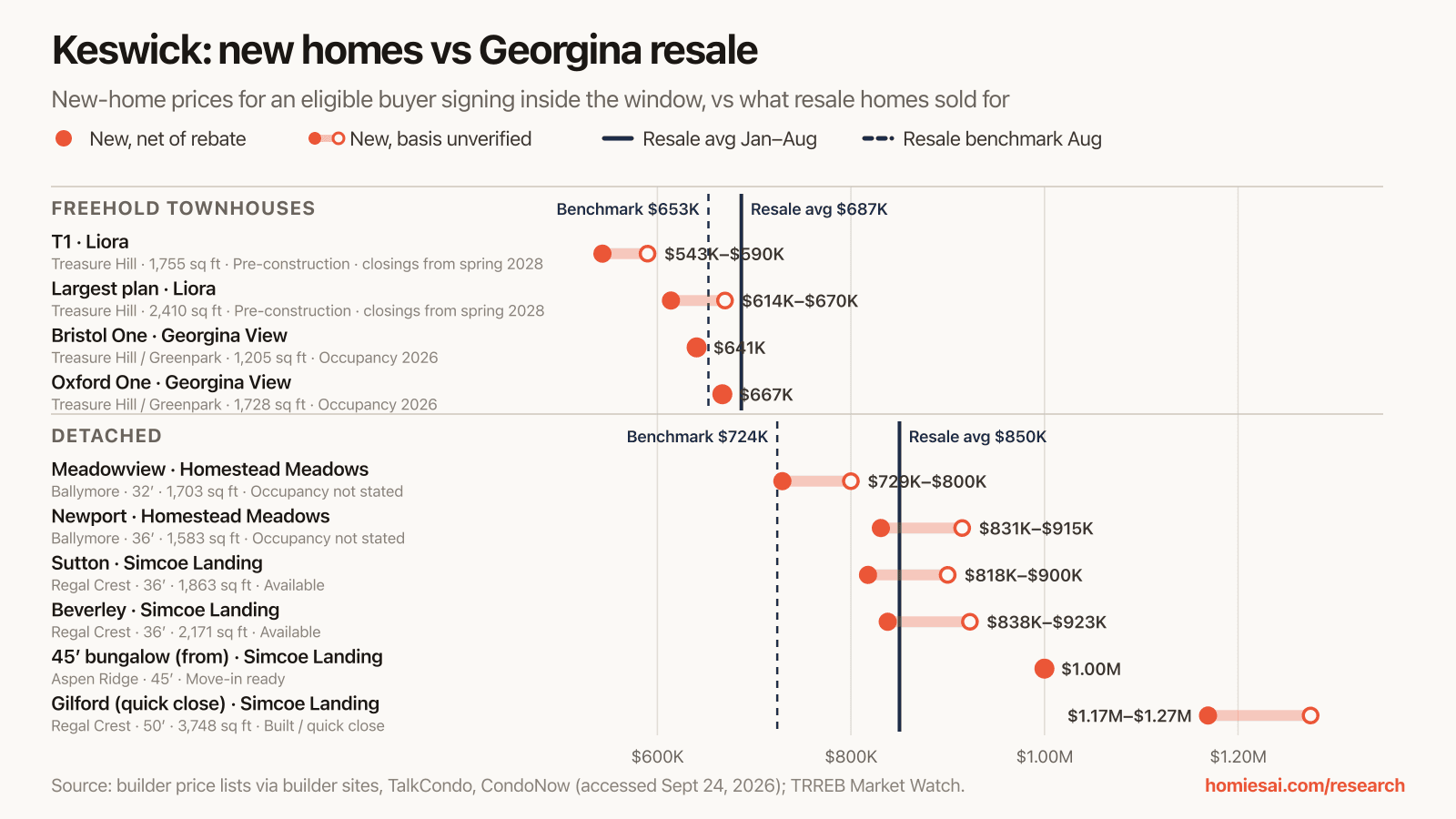
This is the comparison buyers actually make. On one side, current builder prices for homes in Keswick, Queensville, Sharon and Holland Landing, adjusted to what an eligible buyer pays if they sign inside the window. On the other, what resale homes in the same town sold for from January to August, and TRREB’s August benchmark for a typical home.
Builders now show prices two ways, which makes naive comparisons wrong. Some list the HST-inclusive sticker and credit the rebate at closing; others now list the price with the rebate already taken off. Treasure Hill’s Georgina View towns and Aspen Ridge’s Queensville singles are the second kind — their new prices match the rebate formula to the dollar. Where a builder doesn’t say, the charts show a range: the sticker if it is already net, and the rebate-adjusted price if it is gross. That keeps the comparison conservative.
Keswick: new freehold towns at $543,000 to $670,000 after the rebate are below the Georgina resale townhouse average of $686,783, and they are 1,205 to 2,410 square feet. New 32- to 36-foot detached homes land between $729,000 and $923,000, around the resale detached average of $850,219. Queensville: Aspen Ridge’s singles at $1.09 to $1.19 million after the rebate bracket the East Gwillimbury resale detached average of $1,137,506. New towns in Queensville and Holland Landing are 3 to 20 per cent above the resale townhouse average; the smaller Sharon Village towns come in below it.
A new home isn’t always the cheaper choice, and it isn’t the same product. Resale buys a mature lot, trees, a finished street and usually a faster close. New buys a Tarion warranty, lower near-term maintenance, a current building code and, in these towns, more floor area per dollar. The point is narrower and more useful: in 2026, for many Keswick and Queensville buyers, the new home is no longer the premium option.
Keswick: several new homes cost less than the resale average
Part V · New vs resale, side by side- New freehold towns at Liora and Georgina View ($543K–$670K after the rebate) sit below the Georgina resale townhouse average of $686,783 — at 1,205 to 2,410 sq ft.
- New 32′–36′ detached homes ($729K–$923K) straddle the Georgina resale detached average of $850,219.
- Resale buys an established lot and a finished neighbourhood. New buys a warranty, a 2026–2028 build and usually more square footage for the money.
Queensville: new detached homes at resale prices
Part V · New vs resale, side by side- Aspen Ridge's Queensville singles ($1.09M–$1.19M, net of the rebate per the builder) bracket the East Gwillimbury resale detached average of $1,137,506.
- New towns in Queensville and Holland Landing ($855K–$995K after the rebate) run 3–20% above the resale townhouse average ($830,331); the smaller Sharon Village towns ($641K–$700K) come in below it.
- Queensville's new product is larger and pricier than Keswick's, so the par comparison is at the detached level, not the entry level.
Price per square foot, new homes
Part V · New vs resale, side by side · Backup- Keswick new freehold towns: about $255–$532 per sq ft after the rebate. Keswick detached: $312–$578.
- Queensville new detached: $446–$699 per sq ft (the top is a 1,565 sq ft bungalow). Towns: $427–$624.
- TRREB does not publish resale square footage, so a resale $/sq ft comparison isn't possible from public board data.
Real price cuts vs rebate accounting
Part V · New vs resale, side by side- Regal Crest at Simcoe Landing, Keswick: the same plans are 19–27% cheaper than in mid-2025 — well beyond anything the rebate explains.
- Aspen Ridge's $106,000 drops and Treasure Hill's Georgina View towns match the rebate formula exactly: the list is now shown net of the rebate. Same house, different presentation.
- CountryWide Queensville singles are down 5–6%; Regal Crest's Anchor Woods quick-closes are unchanged from the March 2025 list.
Part VI
The economics of substitution
New and resale homes are substitutes competing for the same thin pool of buyers. A subsidy on one changes the price of the other.
Substitutes and cross-price effects. A young family choosing a three-bedroom house in Keswick is comparing the resale semi on an established street with the new town in Simcoe Landing. When the effective price of the new home falls by up to 13 per cent, some of those buyers switch. The resale seller now competes against a cheaper alternative and has to meet it on price, wait longer or withdraw. In the data that looks like fewer resale sales than the region, more listings and weaker benchmarks in the two towns with the most new supply.
Who keeps the subsidy. Tax-incidence theory says the side of the market that can adjust quantity more easily keeps less of a subsidy. Builders came into 2026 with 38.5 months of GTA new-home inventory and unsold singles in these very subdivisions, so their supply was elastic: they could sell more homes without raising prices. That is why the subsidy has mostly reached buyers. Across 768 GTHA floorplans, cuts outnumbered raises almost three to one, and only 3 of 72 increases exceeded the tax benefit. Regal Crest’s Simcoe Landing plans are 19 to 27 per cent cheaper than in mid-2025.
Why new homes cost more to begin with. A resale home carries no development charges and no HST. A new single-detached home in East Gwillimbury carries $153,353 in development charges alone, and about $131,446 in Keswick. Before April, a repeat buyer of a $999,000 new home there paid about $259,000 in combined government charges; inside the window it is the development charges alone. The rebate doesn’t make new homes cheap. It removes the part of the premium that was pure tax.
Demand pulled forward. A subsidy with an end date moves purchases forward in time. For a repeat buyer of a $1.2 million new home, net HST drops from $132,000 to $26,000 on April 1, 2026 and returns to $132,000 on April 1, 2027. Expect a rush of signings into March 2027 and a gap afterwards, unless the window is extended. No extension has been announced. Resale sellers in these towns are competing against a subsidy for the next six months, then against the hangover.
Two products, one pool of buyers
Part VI · The economics of substitution- New and resale homes are close substitutes. Cutting the effective price of one shifts demand away from the other: resale sellers now compete against a subsidized alternative.
- Where the subsidy lands depends on supply. With 38.5 months of new-home inventory, builders couldn't raise prices to capture it; the benchmark fell instead.
- The pressure then passes through to resale: to win a buyer, a resale home now has to price against a new home that just got up to 13% cheaper.
Why new homes cost more to begin with: government charges
Part VI · The economics of substitution- Development charges on a single-detached home: $153,353 in East Gwillimbury and about $131,446 in Keswick (York Region + town + school boards, July 2026).
- Add net HST of $105,870 on a $999,000 home and a repeat buyer paid about $259,000 in government charges in East Gwillimbury before April 2026. Inside the window: $153,353.
- A resale home carries neither charge. The rebate narrows the government-cost gap between the two products by about 40%, but development charges still sit inside every new-home price.
Builders are cutting far more often than raising
Part VI · The economics of substitution- Across 768 active GTHA pre-construction floorplans: 26.8% cut, 63.8% unchanged, 9.4% raised.
- Average cut −7.45% vs average raise +2.88%. Only 3 of 72 increases exceeded the ~13% tax benefit.
- Flat sticker prices are effectively cheaper once the rebate is counted. The subsidy is reaching buyers, not builders.
The cliff: what a $1.2 million new home costs in tax, by signing date
Part VI · The economics of substitution- A repeat buyer signing before April 1, 2026 paid $132,000 in net HST on a $1.2 million new home. Signing inside the window: $26,000. After March 31, 2027: $132,000 again.
- A first-time buyer at the same price pays $78,000 before and after the window.
- Time-limited subsidies pull demand forward. Expect a rush into March 2027, then a gap, unless the window is extended. No extension has been announced.
Part VII
Risks and what to watch
Buying new is a different set of risks, not an absence of them: deposits, closing dates, appraisal gaps and a policy cliff on March 31, 2027.
Deposits and Tarion. Deposits here range from $60,000 to $200,000. Tarion protects freehold deposits up to 10 per cent of the price, to a maximum of $100,000. For agreements signed since April 1, 2026, full coverage requires the buyer to notify Tarion within 45 days of signing. Several Queensville and Holland Landing projects ask for more than the cap.
Appraisal and closing. A home bought in 2026 for a 2028 closing is appraised at closing. If resale prices keep drifting down, the lender may value it below the contract price, and the buyer covers the difference. Closing adjustments — Tarion enrolment, utility meters, any development-charge increases listed in Schedule B — add to the price, and there is no legal cap on the total beyond disclosure. Delayed-closing compensation is capped at $7,500.
Supply after 2027. East Gwillimbury started 1,322 homes in 2017 and 22 from January to August 2026. Georgina started 412 in 2023 and 59 so far this year. Today’s buyers are absorbing homes planned years ago. With starts this low, the new-home discount may not last beyond the inventory that already exists.
The cost of entry: deposits
Part VII · Risks and what to watch- Deposits in these projects run from $60,000 (Liora, paid over 300 days) to $200,000 (Anchor Woods quick-closes).
- Tarion protects freehold deposits up to 10% of the price, capped at $100,000 — and for agreements signed since April 1, 2026, only in full if the buyer notifies Tarion within 45 days of signing.
- A pre-construction deposit is tied up until closing, which can be 2028. Quick-close inventory gives the rebate without the wait, with less choice of lot and finishes.
The pipeline is running dry: housing starts
Part VII · Risks and what to watch- East Gwillimbury housing starts: 1,322 in 2017, 676 in 2022, 92 in 2025 and 22 from January to August 2026.
- Georgina: 412 in 2023, 161 in 2025, 59 so far in 2026.
- Today's buyers are absorbing inventory planned years ago. With starts this low, the supply of new ground-oriented homes in these towns thins out after 2027.
Buying in Keswick, Queensville or East Gwillimbury
See the full price lists before March 31.
Book a free 30-minute call. I'll walk you through current builder price lists and quick-close inventory, how each builder handles the rebate, and how those homes compare with resale on your street, so you can decide on the numbers.
Price lists
Current lists and quick-close homes across Keswick, Queensville, Sharon and Holland Landing.
Rebate check
Whether a price is shown gross or net of the rebate, and what you actually pay.
New vs resale
A side-by-side with recent resale sales for the size and street you want.
Risk review
Deposits, Tarion coverage, closing dates and Schedule B adjustments.
What would change the call
Five things to watch
- 1
An extension of the window
If Ontario and Ottawa extend the all-buyer rebate past March 31, 2027, the pull-forward softens and the substitution lasts longer. Nothing has been announced.
- 2
The September and October BILD releases
If single-family new-home sales keep falling from July's 781 and August's 692, the program's momentum is fading before the deadline, not building toward it.
- 3
Georgina and East Gwillimbury benchmarks
Continued underperformance against York Region into the fall would strengthen the substitution reading. A catch-up would weaken it.
- 4
Resale new listings
East Gwillimbury sellers are already stepping back (new listings −16.7% from April to August). If more follow, resale supply tightens and prices stabilize.
- 5
Builder price lists after the deadline
Whether builders hold today's net prices after April 1, 2027, or restore the tax, will show who ultimately bears it.
Method, sources and caveats
Resale. TRREB Market Watch reports, January 2025 to August 2026, plus February and March 2022: municipal and per-type tables for East Gwillimbury and Georgina, York Region and all TRREB areas, and the MLS® HPI composite, detached and single-family-attached benchmarks. Each month is as first published. Period averages are dollar volume divided by sales. Community-level figures come from TRREB’s Q2 community reports. Sample sizes are small (19 to 85 sales a month per town, one to twelve townhouses), so single months are noisy. TRREB has revised its index since 2022, so the peak comparison is approximate. TRREB doesn’t publish resale square footage, so the side-by-side compares prices, not price per square foot.
New homes. Builder price lists and quick-close pages (Treasure Hill, Greenpark, Ballymore, Regal Crest, Aspen Ridge, CountryWide, Lakeview, Wycliffe/Thornridge), TalkCondo and CondoNow, accessed September 24, 2026. Livabl was the preferred source, but its bot protection blocked all but one page, and we did not attempt to get around it. Prices are list prices and may differ from negotiated prices. Where a builder doesn’t say whether the list is gross or net of the rebate, the charts show both. Lakeview’s townhouse prices are from a March 2025 list that was still posted. GTA new-home figures are BILD / Altus Group; Altus revises prior periods, so 2025 comparisons use the figures first reported. BILD’s public releases don’t break out York Region.
Policy. Rebate amounts follow the CRA, Ontario Budget 2026, ontario.ca and Finance Canada. The phase-out between $1.5 million and $1.85 million is drawn as linear; the published rules describe it as proportional. Development charges are the July 1, 2026 York Region, East Gwillimbury and Georgina schedules for a single-detached home. Housing starts are CMHC’s Housing Market Information Portal. Deposit protection is Tarion’s published rule for freehold homes.
Read with care. The before-and-after and difference-in-differences comparisons are descriptive. They are consistent with substitution from resale to new homes, but they don’t isolate it from other changes in 2026. This report is market research, not tax, legal or financial advice. Confirm rebate eligibility with the builder and your lawyer before signing.